“Never, ever underestimate the degree to which people will scatter themselves into a deep fog in order to avoid seeing the basic realities of their own cages. The strongest lock on the prison is always avoidance, not force.” (Stefan Molyneux)
Writer: Brandon Seifert Artist: Ibrahim Moustafa Creative Consultant: Chris Mowry Publisher: IDW Released: 21st October 2015
It’s subtle, you can’t see it, you are wrapped within the life lie, fighting battles, throwing punches, avoiding kicks, but truth is outside the war-zone of rat-race concerns, realise that death is an illusion, blast through the hidden wall, walk into the white, for there, alone, you will find reality.
Rating: 9/10
There’s a heck of an allegory going on in this comic book, and it’s so subtle that it can be easily missed. Godzilla is fighting various monsters, but after a while he realises that something is afoot. He cannot die, so he realises that the fight isn’t real. With this knowledge he decides to focus his energy on escaping from the unreality that has caged him. He comes across a wall, uses guile, intellect and brute strength to break through it, sees the white light of endless possibility, and walks straight into it. That’s the end of the book, and to find out more about that white light we’ll have to wait for Godzilla in Hell #5. Here’s my take on the allegory: Godzilla is in the world that we all inhabit. He spends his time fighting for dominance, as we all do. However, Godzilla realises that death is an illusion, as it is in our own holographic world. With this knowledge of truth, he breaks free from the Matrix that has caged him in flight or fight/rat-race/survival of the fittest non-reality, and into truth, into the real world beyond the Matrix. Godzilla is Neo, breaking through the Matrix, but is he going to wake up in a tank of Goo like the Matrix movie? Will he find himself on a movie set like the Truman show? Or perhaps he’ll just walk out onto a blank page and argue with the writer, like that old Daffy Duck/Bugs Bunny cartoon? Whatever it is, I can’t wait to find out what is going to happen next. This book has been great. It’s the subtlety that does it, that and an overarching concept that has tied everything together to create what is an absolutely fascinatingly individualistic, yet collaborative whole.
For me, this ostensibly ‘daft’ series about Godzilla in the land of the big red guy has been the surprise hit of 2015. I expected a laugh from it, but what I have got is an excellent platform for artists and writers to show off and really explore their own creative inspirations.
Every month there has been a different writer and artist. I’ve reviewed all three months, so if you want to know what happened in the previous two issues then check them out on my blog. I strongly advise that you do, as they really do have a lot of offer.
Last month the art and concept was the star, but this month it’s all about the concept. The art serves this month, taking a backseat to the power of the story, and what it is so concisely (and successfully) trying to say.
The narrative structure is simple. Godzilla has a fight on earth. He blows it up, goes to Heaven, has a fight in Heaven, goes to Hell, has a fight in Hell, wins, leaves, alone, independent, unconquerable, refusing to join, refusing to submit to anybody, even Heaven itself.
It could read as being a bit daft, but it really isn’t. What is happening here is a comic book analogy of the real world battle between individualism and collectivism.
Godzilla refuses to join, and it doesn’t matter to him one jot whether it’s Satan or God himself that is asking him. He refuses because he is an individual. He couldn’t care less about factions, or ideology. He fights for himself. He rejects leadership, rejects followers, rejects kingship, and fights not for dominance, but for the moral right to be left alone and to be separate from the eternally warring collective.
Godzilla is the ultimate realisation of an anarchist freedom fighter. He isn’t heading up a Marxist or even right leaning anarchist army and going to war for dominance. No, he’s doing what all real anarchists should be doing, he’s refusing to join the collective group think ideology of any political constitution, and going 100% libertarian anarchist, and fighting for his right to be left alone from any external collectivist, group-think control system.
When Godzilla wins a battle he turns his back, and leaves. He has won, but the spoils of war do not interest him. He rejects followers, territory, power and (most importantly) authoritarianism collectivism.
Godzilla won't be led, and he certainly won’t be a leader either. It’s that mindset that is really going to change the world, the mindset of the independent individual who will not join, will not submit and will not lead another cult of collectivist followers.
Go your own way, do your own thing, embrace the life of a truly free individual, fight your own battles, for yourself, reject the collectivism of any group-think ideology, force yourself to be free, force yourself to be like Godzilla.
Rating: 8/10 (For it’s strong moral message of individualism versus collectivism this one is a winner)
Adapted by: David & Scott Tipton Art: Ron Joseph Publisher: IDW Publishing Released: 26th August 2015
I purchased this book because I am a long time consumer of everything and anything to do with the character of Sherlock Holmes. I thought that it was something new. I was mistaken. It’s not new at all.
The original book from 1974.
‘The Seven-Per-Cent Solution: Being a Reprint from the Reminiscences of John H. Watson, M.D. is a 1974 novel by American writer Nicholas Meyer. It is written as a pastiche of a Sherlock Holmes adventure, and was made into a film of the same name in 1976.’ https://en.wikipedia.org/wiki/The_Seven-Per-Cent_Solution
I blame myself. I should have checked the previews before I purchased the book. I remember watching the movie over twenty years ago. I didn’t like it. The plot takes two original Conan Doyle stories and has Doctor Watson admitting that he made them up in order to save the reputation of Holmes.
The Sherlock Holmes in this tale is a paranoid, cocaine addicted, conspiracy theorist. The general gist of the plot is that his main nemesis, Professor Moriarty, is not a criminal mastermind, but an old mathematics teacher who Holmes mistakenly thinks (due to his cocaine addiction) is the, ‘Napoleon of Crime.’
The message of the book is that conspiracies do not exist, that life is random, and that crime is committed by ‘crazy’ individuals, and not organised by intelligent, well-connected groups of people who help each other out.
I guess that organisations such as the Bilderberg Group, Bohemian Grove, Trilateral Commission, Council on Foreign Relations and the Bank for International Settlements don’t exist after all? They must all be a figment of our collective imaginations, I guess?
This message in ‘The Seven-Per-Cent Solution’ goes completely against the original stories of Sir Arthur Conan Doyle, and reinforces the mainstream idea that is pushed by Rockefeller funded educational institutions. You know the idea, right? Watch television, you’ll see it.
Here’s how it goes: Life is random, chaotic and cruel. There are no elite groups, just individuals. It’s a survival of the fittest zoo out there. Kill or be killed, be more ruthless than everybody else, there is no God, there is no morality, all is psychology, we are animals, Darwinian monkeys in a meaningless game. There is no such thing as ‘conspiracies.’ You’re all alone kid, and you need to get climbing up that greasy corporate pole, because that’s all that there is.
It’s a message of idiocy. A message that ignores reality itself, and promotes the kind of world that we have today in collapsing western countries, a world with easily manipulated masses and competing groups of ‘elite’ world controllers that play us off against each other with disdainful ease.
Sherlock Holmes was not a stupid man, but in this book, that is exactly what he is. That is why I disliked the 1976 movie. I disliked it because it portrayed Holmes as somebody who was not Sherlock Holmes. It portrayed a drug addict slipping into paranoia, not the best mind in England, not the man that I read in Conan Doyles’s original books.
I can understand why this comic book exists today. I understand why a 1974 novel has been rehashed into comic book form and here’s my own ‘conspiracy’ mind going into crazy land, and no, I’m not a bloody cocaine addict. I’m a boring, teetotal vegetarian who exercises twice a day.
Here’s my take on why this book exists: So called ‘conspiracies’ are becoming all too real now, thanks to the Internet. People are ignoring the mainstream indoctrination centres (television and the education system) and are looking at things for themselves.
What they have discovered is groups, large, wealthy groups, connected to international banking institutions, that make money out of nothing, loan it to supposedly ‘sovereign’ governments, at interest, and act like a vampiric spider in a world-wide web of evil, manipulation and human enslavement.
That’s what people see, not because it’s a ‘conspiracy,’ but because that’s how the world actually works. Conan Doyle knew how the world worked, and that’s why he created the character of Professor Moriarty, to encapsulate that conspiracy, and to put a face on the globalist spider in the centre of the world that feeds on us all.
‘The Seven-Per-Cent- Solution then is the mainstream’s attempt at discrediting the idea of a ‘conspiracy.’ Why IDW is putting this in comic book form in 2015 says a lot about where that comic book company stands. I’m not saying that they are part of the ‘conspiracy,’ itself. What I am saying is that there is some serious cognitive dissonance going on here, and that rather than deal with the revealed world as it is today, they are going back into the past in an attempt to validate their entrenched, indoctrinated beliefs about how the world works.
IDW sees no evil, hears no evil, and speaks no evil. They are a little comic book publisher that wants to be a big comic book publisher, and their mindset, rather than coming from the point of view of the underdog, is coming from the point of view of a servant that just wants to eat at the masters table.
I can understand that mindset, but I don’t have to admire it. We have the Internet now, and truth is available, if you want it.
We don’t have to accept the lies of the mainstream anymore. The lies taught to us by our televisions, teachers and newspapers are now naked before us, and we can finally see them for what they actually are.
Truth is now available. It’s on our telephones. It’s up to us, as individuals, to do the work, we can find reality, we can find truth itself, if we want it.
This comic book is pushing the mainstream lies of the discredited past. It’s a 1974 book that mocks the idea of a criminal conspiracy, and in 1974 it could have worked, but not now, not in 2015. The game is up, truth is getting out, and if all they can do is go back to the 1970’s to discredit it, then that says more than anything that I can put together here.
Rating: 5/10 (Faithful, solidly written comic book adaptation of 1970’s book that portrays Holmes as a paranoid conspiracy theorist)
Art & Story: Bob Eggleton Edits by: Bobby Curnow Letters/Creative Consultant: Chris Mowry Publisher: IDW Comics Released: 26th August 2015
‘Godzilla in Hell’ sounds very silly, trite and D level, but this comic book is a lovely thing to look at, and it really brightened up my day.
The concept behind the artwork is explained by artist (and writer) Bob Eggleton at the conclusion of the issue, and not only do you get to look at some beautiful painted panels of artwork, but you get a bit of an art history lesson as well.
The first issue of Godzilla in Hell was having a laugh at the way too serious and up it’s own jacksie ‘Age of Reptiles.’ It had no dialogue, no narration, and the story simply (and silently) followed our big ferocious lizard hero as he beat up random monsters in Hell. It was funny, silly and a riot to read.
Godzilla in Hell #2 is similar, but very different. First off, there are words in this one. An omniscient narrator guides you through the panels, explaining who is who, and what is going on. This narrative voice uses bombastic, flowery, hyperbolic prose and creates an epic, almost biblical feel to the narrative.
It could be a bit over the top to some, but I enjoyed it, a lot. The art has grandeur, so why not reflect that in the text as well? To me it worked, and it really added to the feel of the book, plus it gave some clarity to the narrative events as well.
Don’t be put off by the silly title on this comic book. Godzilla in Hell #2 is a lovingly crafted treat for the eyes, and you’ll be missing out on some beautifully painted artwork if you decide not to check it out. Get down to your comic book shop, find a copy, flip through the pages, and you’ll see what I’m trying to say here.
The book might not be saying a lot, so for a comic book reviewer obsessed with reality like myself, this is never going to get a 10/10. The best rating that I can give it is a seven. A seven in my scoring system indicates a top quality book that is not addressing real world issues.
Yeah, I know, my rating system is ridiculous, but I’m the self proclaimed ‘Anti- New World Order Comic Book Reviewer,’ so that’s what I’m looking for in my books, and there’s none of that going on here.
Forget my rating on this one, this is a book that you’ll want to check out. Buy it for a beautiful, lovely five-minute diversion from essential reality. Buy it for the art. It’s lovely, it really is, and even a reality junkie like myself couldn’t help but be mightily impressed by it all.
Rating: 7/10 (Beautiful painted art, and a fascinating concept based on art history.)
Original book by: Richard Matheson Adaptation: Ted Adams Art & Design: Mark Torres
Publisher: IDW Comics
Released: 29th July 2015
Is there a huge demand for new comic book adaptations of science fiction novels that were popular in the 1950’s?
I’m not trying to be a condescending a*** hole here. All I’m doing is posing a question that I myself would be interested in hearing the answer to.
I’m asking this question because I have just read a 2015 comic book that is setting out to faithfully adapt a 1956 novel, ‘The Shrinking Man,’ by Richard Matheson, and I’m thinking to myself, does this really have an audience?
I read ‘The Shrinking Man’ #1 blind, unaware of any of the history behind it, and my initial reaction to it was, why is it being set in the 1950’s?
Now I know, and I don’t quite know how to feel about it. The comic book certainly reads like an adaptation of a 1950’s novel. It’s slow, not much happens, and it’s all about the main protagonist, a bloke who is getting smaller and smaller.
This first issue tells the ‘before’ story of the shrinking man, exploring his thoughts and concerns about his condition. Understandably, he’s not very happy about it. During the book we see him moaning to his wife and going to some scientists in the hope that they can cure him. Evidentially they failed to stop the shrinkage, as when the book switches to the present he is shown to be just the right size to be gobbled up by a spider.
The spider action could have brought some excitement and danger into the narrative, but all the spider does is chase him. There is no confrontation, no fight, no dramatic escape, and when the spider is poised to attack our hero, the narrative jumps to the future, missing out on all of the exciting action that presumably happened in-between. I guess he survived the spider attack, because he’s still alive, but why wasn’t it shown? This is very unsatisfactory.
Strangely enough, the spider and imminent painful death isn’t our heroes main concern. His main concern is how he is going to get some food, and the issue concludes with a very hungry and frustrated little man looking at some soggy crackers. No imminent spider attack, no danger, no tension, no excitement, just boring old soggy crackers, a little man and a rumbling tummy.
Is that supposed to make me feel excited about getting the second issue? Soggy crackers are no cliffhanger. A venomous spider about to devour our protagonist as his hands slowly slip from a table is a cliffhanger, but soggy crackers? I’m sorry, that’s just not cutting it.
I love the retro cover (by Mark Torres), and I’m a huge fan of old comics, so I should have enjoyed this book, but there was something a bit too pedestrian about it all.
It should have been a thrill a minute rollercoaster ride with danger at every corner and a heart stopping cliffhanger to top it all off. That’s what it should have been, but what I’ve actually read here is a plodding narrative about a depressed little man and his box of soggy crackers.
The Shrinking Man will certainly be more interesting to read in trade-paperback, but as a monthly comic book it appears that the adventures of this miniature man from the 1950’s is going to be a long, slow, drawn-out, and not particularly exciting or urgent reading experience.
Rating: 4/10 (Slow, and lacking in moments of danger, tension, urgency and excitement)
Writer & Artist: James Stokoe Publisher: IDW Publishing Released: 15th July 2015
If you want a two-minute book about Godzilla falling into Hell, and smacking demons upside the head, then this is the book for you.
There is no dialogue, Godzilla doesn’t talk, he gets angry, and beats things up.
There is no story other than Godzilla walking, coming across a threat, eliminating said threat, giving his ‘Is that all you got?’ look, and moving on to beat up whoever else dares to threaten his physical well-being.
I like his attitude. Leave him alone, and he’ll leave you alone. Cause him trouble, and he’ll sort you out.
The art in this book has scope, it’s big, it’s red, it’s fiery, it’s dangerous, it’s hellish, and there’s Godzilla amidst it all, not caring one jot. It’s big here, but so what? Its bottom kicking time.
This is a fun book, but there’s one note of seriousness that I want to address. The Hell in this book is full of people, tides of people, they are faceless, grains of sand in an endless storm of misery.
Why so many people? Surely you have to be really evil to get thrown into the fiery pits of Hell? Don’t you have to do something really, really, really bad to get there?
Nope, you don’t have to be Hitler or Tony Blair to get into Hell. All you need is to be the ‘good’ sort who spends his life keeping his head down, not making waves, paying the bills, paying taxes, paying for the state.
Hell is full of people who tolerate evil, and spend their lives doing nothing to stop it. It was easier to go along to get along, rather than doing something to make the world a better place, so they do nothing, and evil continues to rule the world.
This mentality of co-operation allows tyranny to continue, not just in the past, but today as well, and the people in charge only maintain their positions because of the quiet acquiescence of the silent, cowardly masses.
That silent, cowardly acquiescence has a price, and the Hell of the afterlife is a living metaphor that becomes all too real when you put down your comic book and take a look at the world around you.
Have a look. Who is in charge of the world? Evil mate, evil is in charge of the world, and who put it there?
That was us, we put it there, and we continue to support it every single day.
Hell is not an abstract construct, a child’s story fed to you by religious leaders in order to scare and pacify you into obedience to their control system. Hell is what we have created through passive, silent, quiet acquiescence to uniformed, governmental authority figures.
Hell is not underground.
Hell is not in the after-life.
Hell is this world.
We are living in Hell.
Hell is now.
Don’t kid yourself about this book. It’s very basic, very, very basic. It’s a toilet book. A book that you will flip through on the bog, enjoy the art, colouring and ass kicking, and then stick on your wall, or keep for your collection because it was a lot of fun and you really like the cover.
I got the Jeff Zornow cover (the one at the top of this review) and it’s cool, really, really cool. I love it, it’s going on my wall, and it’s going to look bloody amazing there.
I enjoyed Godzilla in Hell #1 as the two-minute funfair ride that it is. The book made me smile, that’s enough for me, making me smile is not so easy. I’m an overly serious bugger, so big kudos to Mr. James Stokoe, the artist and writer of this comic book. You achieved the damned near impossible James. You made this ranting and raving reality junkie comic book reviewer drop his guard, relax, smile and actually enjoy himself for a change.
Cheers mate. Thanks for the book, sorry about the Hell rant in this review, but that’s what I’m like. Annoying, relentless, self-righteous git that I am, one hint of real world concerns and off I go, ranting away, screaming into the vast, empty, indifferent Internet void, chopping away at the beast that controls the world, and sounding away like the only sane person left in a world-wide psychiatric ward.
Writer: Chuck Dixon Artist: Esteve Polls Colours: Diego Rodriguez Publisher: IDW Released: 20th May 2015
I like Winterworld because it takes its time. It is confident, it has a story to tell, it doesn’t panic, there is no rush to impress here, the story is all, and it’s a good one.
Don’t worry if you haven’t read the book before, it’s not difficult to follow.
The story is about humanity, about living in a cold place where you struggle to keep your belly full, and to survive the biting cold not just of the weather, but of the human heart.
I’m not being clever here, that’s what the book is about. It’s about the coldness that infects the human heart, not about the weather.
Winterworld Frozen Fleet #1 has human disappointments, contradictions, and an encounter with a savage tribe. The savage tribe hunts in a pack, like wolves they have left their humanity behind, becoming Darwinian, like a pack of suit wearing executives at HSBC bank, morality no longer figures in what they do. They want something, and if they have to stamp on an anonymous human face to get it, well, that’s not going to be a problem for them.
Being cold is a test. Can you keep the warmth in your heart alive, or will the cold erase your humanity? How many of us compromise our moral values for a career, a relationship, a car, friends, some petty material warmth that puts the soul man in a freezer, and the animal man in a pack of wolves?
I contemplate these issues when reading this book, and then something lurks from beneath, a mystery, and the story that was taking it’s time becomes hugely exciting, ending on a cliff-hanger, with questions, with our heroes, our soul warriors in alarming peril.
That’s how you write a comic book. Emotional connectivity, an underlying questioning of what it is that makes us human, then danger, momentarily thwarted, ending with the protagonists looking down the barrel of a gun.
Winterworld is a far better comic book than I ever thought that it would be. There are no gimmicks here, this is a book reliant on superior story telling, not click bait gimmickry. Chuck Dixon poses questions about what it is that makes us human, he touches the heart, massages the brain, then puts his foot down on the accelerator and kicks his narrative into high octane action overdrive.
When the action kicks off you care because he’s taken his time, told a story, and made you emotionally connect with the people now fighting for their lives. That’s how you write a good comic book, and that’s how you make people care.
The world is cold, we all need a bit of warming up every now and then, and Winterworld: Frozen Fleet #1 is the perfect hand warmer for these austerity bitten times. It’s so easy to fall into apathy, to go into survival of the fittest mode. Why not just get a job at a bank and screw people over for a living? After all, that’s what all the successful people are doing, right?
I think I’ll turn down the chance to screw people over. I don’t want to join the pack of wolves. I’ll stay alone, reading comics, trying to stay warm, and trying not to let the cold of the world freeze up what remains, flickering, warmly, stupidly, optimistically, within.
Rating: 10/10 (A superior comic book about the human heart)
Writer: Chris Lewis Artist: Bruno Oliveira Publisher: IDW Comics Released: 22nd April 2015
So, here it is at long last. A comic book that is actually going to look at the favourite dehumanising murder weapon of the neo-liberal elite’s, the death from above that is the satanic predator drone.
How to deal with such a subject matter? How do you look at a nasty bit of US imperialism in a comic book without depressing all of the (largely American) readers? How do you make the drone pilots look like the heroes that are demanded by the corporate whore mainstream media? After all, they sit in a warehouse and murder people all day, a lot of those people being women and children and civilians just getting on with their everyday lives. It’s going to be difficult isn’t it?
Readers might get upset. They might not want to read a comic book about nasty US war policy. There is a reason why comic book geeks prefer the insular safety of their superheroes fighting aliens and cold war era Russians. It’s a nice safe nowhere land where they can pretend that Nato and the west are somehow making the world a better place, and not doing what they are actually doing.
That’s what comic books offer, a respite from the unpleasant reality around you, a reality where your tax dollars are used to bomb the crap out of countries for banks and corporate interests. The countries are then turned over to the Sunni proxy army (known as ISIS this week, I think) to completely destroy what is left and behead anybody that disagrees with their ideology of turning the country back to the stone-age. Ah, welcome to reality in 2015, got anywhere I can hide?
Comic books let you hide from the desperate, pleading hunger pangs of your guilty conscience. They offer you a comfortable hole in the sand where you can safely place your head and pretend that the world that you’ve helped to create and maintain doesn’t actually exist.
So, yes, it’s going to be difficult to write a comic book about drone pilots in 2015, a time where reality is thinning out, and what is left is some bizarro fantasy land with comic books existing in a alternative dimension immune to reality post 9/11.
Writer Chris Lewis could have been really brave and shown the drone situation for what it really is. He could have written a comic book about the horror of it all. He could have focussed on children terrified to look at the clear blue sky, knowing that somewhere a drone could be lurking to rain death from above. He could have done that, but that’s expecting too much. Like I said before, people would be upset, soldiers would look like the murderers that they actually are, and people (comic book readers in their fantasy 1990’s nowhere land mainly) wouldn’t want to read that kind of book.
What he has decided to do instead is construct some kind of weird sexy fantasy narrative that is commenting on the pornographic nature of watching war on television by turning his entire comic book into an exact duplicate of that sick televisual popcorn and bombs experience. His characters are silly, everything is a joke and none of it really matters because it’s not serious, it’s not real, and it’s pretty much a waste of everybody’s time, exactly like the television war porn that I guess it’s attempting to satirise.
I didn’t like it, and it took me a while to understand what exactly it was trying to do. To me it read like a very disrespectful way to talk about a serious subject matter. I found it depressing, empty, shallow and desperately trying to be clever whilst somehow not being very clever at all.
There’s something fat, smug and American about this book, and that’s coming from a guy who likes America. I understand that is the whole point of the comic book, that it’s satirising that dehumanised mind-set, but by doing so it has fallen into the trap of becoming exactly what it itself is attempting to mock. People will read this, have a laugh, and nothing will have changed. All resistance to US corporate sponsored neo-liberal imperialism will be labelled as terrorism, and the drones will continue to fly.
If you want to get a serious comic book that looks at the impact of drone warfare and how it has become nothing more than a recruitment tool for insurgents fighting US/Nato wars yet to come then you won’t want to read this book. The light-hearted way that it is scripted, the banality and unlikeability of ALL of the characters is nauseating and whilst others will read the book, feel confused, then leave it be, I have to call it out for what it actually is.
Drones #1 is a deeply unpleasant comic book. It has taken a delicate subject matter and turned it into a very unfunny joke. If there is subtle social commentary going on here then it’s lost underneath a wave of comic book silliness. Drone warfare is state-sponsored murder. No evidence, no trials, no judge, no jury, no law. It is terrorism, designed to terrify an entire country, so to see it being portrayed in such a light-hearted, inhumane, jocular manner is a bit shocking really. I should be disgusted, and it shows how much I’ve been normalised to the horrors of our time that the abiding emotion I feel after reading this book is merely disappointment that a comic book about drone warfare could be so depressingly banal.
Writer: Joe Harris Artist: Colin Lorimer Colourist: Joana Lafuente Publisher: IDW Comics Released: 1st April 2015
Millennium has been a very enjoyable series so far. The art is great, the colouring’s superb, the script is interesting and the construction of the narrative itself has a screenplay element to it that makes the entire experience feel like you are watching an old episode of the X-Files television show.
That screenplay element is in use again at the beginning of issue #3 with a plot device that is usually used in television dramas. A moment of high (spooky) drama opens the narrative, before the story flashes back 24 hours so the viewer can see the prelude to the dramatic scenes that are now unfolding.
I enjoy that technique, it brings you straight into the narrative with a monument of adrenaline, hooking you into the story with drama, and having you hang around for an explanation about the context behind that drama.
As with all ‘conspiracy’ shows the game here is to hint at what is to come, revealing slowly, drip by drip, tantalising clues about the bigger ‘conspiracy’ picture behind surface events. Throw in some interesting characters, have a daughter kidnapping (that always works) and you have a show.
It sounds like, from what I’ve just been underlying here, that this ‘Millennium’ book isn’t exactly busting with originality, and that’s a pretty fair accusation to lay on the project. It’s not original, but that doesn’t mean that it’s not any good. Yeah the references are a bit old (The Millennium Bug and the Pixies) but for people over the age of forty (that’s me) there’s still fun to be had here.
If you pick up this title you’ll get a mixture of X-Files nostalgia (like the returning show) good art and a well-paced and competently executed script. I’m enjoying it, but bear in mind that I am a 41 (almost 42) year-old guy who grew up with this stuff on his television during my prime (they weren’t really prime, I was terribly depressed back then) twenties years.
This book transports me back to the days when the X-Files was the coolest, newest, edgiest show on television. That’s not really the case anymore, and if you expect the upcoming new shows to be anything other than nostalgia I fear you are in for some disappointing viewing.
The X-Files was of it’s time, and as I read ‘new’ versions of it today I come away with the feeling that it’s not connecting with anything that has happened post 9/11.
All of the usual globalist, New World order, failing democracy, surveillance and illegal, never-ending war stuff that I always talk about in my reviews, and want to see reflected in my comic books isn’t really happening in this book, or any of the other X-Files titles coming from IDW Comics.
That’s okay. If you want to talk about new stuff you have to update the vehicle, and the X-Files wagon is a bit rusty these days. It’s become a nostalgia thing, and when it’s done well it still has something to offer, at least to blokes like me who grew up with this stuff during our late teens or twenties.
I like this book, but I’m being realistic about it here. I’m not going to pretend that something game-changing is happening.
It’s a nostalgia book, done well, that is centred on a conspiracy group that was designed to cash-in on the silly (and it always was silly, this is not hindsight) Millennium bug fears of the late 1990’s. Get Millennium if you miss the X-Files and are looking forward to the new television shows. The book looks great, the story is interesting and the entire project has been carefully and thoughtfully constructed.
Rating: 7/10 (Nostalgic fun for the 35+ generation)
Writer: Steve Niles Artist: Damien Worm Publisher: IDW Released: 25th March 2015
There is one good idea in this month’s ‘The October Faction,’ but apart from that it’s just the usual combination of a story with a muddled tone that features some very cool, gothic artwork.
The good idea is that a bloke who turns into a werewolf is suffering from terminal cancer, but that it doesn’t appear to affect him when he’s a wolf, it's just the human side that’s done for. The obvious solution to the problem then is to stay as a permanent wolf. That’s interesting, but I don’t see how it’s going to be well used in this story that is ostensibly about a jokey Adam’s family/Munsters group and their inconsequential, don’t take all of this too seriously, adventures.
Put the wolf/cancer thing in another book, a book that has a serious tone, take the same artist with you (the fantastic Damien Worm) and then you’ll have something that would really be worth following. Perhaps the wolf blood can be used to cure cancer? But does that blood have other side (murder related) effects?
Do you see what I mean? It’s a good idea isn’t it? It has loads of possibilities, and you could do an entire little series about it. But having that idea in this book as it is, with the comedy tone, and the feeling that nothing really matters, I don’t like to say this, but it’s just not working.
This is particularly evident in issue #5. The book concludes with a cliff-hanger where one of the main characters is put in a life or death situation. That’s a big deal, right? Well, it should be. It should have a huge, dramatic impact, but because of the casual tone of the book the impact is negligible. You can’t take it seriously, because the book isn’t serious. The entire tone of the narrative is silly, light and inconsequential. You can’t get involved in it, and you can’t take any threats to the protagonists seriously, because they themselves are not written seriously.
Getting emotionally engaged in this book would be like getting worried about Wile. E Coyote as he flaps his arm and falls helplessly to the bottom of the mountain. You don’t worry about poor old Wile. E because he’s a cartoon. He’ll be fine, don’t worry about it. That’s the same feeling I get with the characters in this book, the only difference is that the Roadrunner cartoon is funny, whilst this book is just a big old muddle.
I don’t understand what the writer is going for here, or what I am supposed to make of it all. It confuses me. I don’t understand what it’s trying to be. It’s not funny enough to be a dark comedy, and not interesting or emotionally involving enough to be a drama, plus it looks spooky and creepy, but the story isn’t scary at all.
I love the dark, atmospheric, spooky art in this book, but I can’t pretend that it’s a superior comic book just for the art alone. Take away the great art from this book, and what do you have? Let’s be honest. It isn’t great. It’s okay, but in a comic book market flooded with okay isn’t it about time that we started to ask for something a bit better?
Rating: 5/10 (Plodding script, but I loved the art, as I always do with Mr. Worm)
Writer: Joe Harris Artist: Colin Lorimer Colourist: Joane Lafuente Publisher: IDW Comics Released: 18th March 2015
Along with the gloriously gothic and spooky regular cover from menton3 you get some equally atmospheric and splendidly coloured interior art in Millennium #2.
This is a book that you’ll want to enjoy with the lights on, as every page is awash with psychedelic swatches, blurs and shades of dazzling colour, creating an effect that’s really quite impressive and a joy to experience.
I’m one of those reviewers who doesn’t usually mention the art and colouring, so the very fact that I’m mentioning it here must mean that it's stand-out good. Actually it’s a lot better than good, it’s great, and bottom line, a heck of a lot of fun to look at.
The story itself is inoffensive to this jaded anarchist, even though it has murders in it, but I forgive that as it’s a conspiracy/murder-mystery genre book and I guess you have to sprinkle a few corpses around a bit to make it what it is.
The book, at the moment at least, is in the stage of the narrative where things are still being hinted at, and the fun to be had here is to follow it all the way through and see everything link up at the end.
The key is whether or not it’s interesting enough that you want to hang around. I do, not because it’s a ‘conspiracy’ book, but because the art is great, there’s nothing in it that offends me too much and the plot is interesting.
I want to follow that plot to the end. I want to know what is happening. I want to slowly find out where it’s all going and I want to find out with the evil villains are up to in relation to unleashing evil into the world (err lads, it’s already here, it’s in charge, and it’s called ‘Government.’)
I’ll keep on buying it, and I’ll keep on putting my lights on when reading the book in order to get the full benefit of the very good art and absolutely stunning colouring work by Joane Lafuente.
If you like the X-files, and if you like books where occulted groups are getting up to mischief, only to eventually be thwarted by brave agents of the state (sorry, but that’s what’s happening here) then you should get a kick out of it. It’s atmospheric, subtle, interesting and well worth spending a couple of quid on. Just look at that front cover with a Slender Man/Demon on it. That’s great, and the book itself isn’t too bad either.
Rating: 7/10 (Not exactly government shattering, but it’s a fun read)
Writer: Chuck Dixon Artist: Tommy Lee Edwards Publisher: IDW Released: 4th March 2015
Winterworld ‘Wynn’s Tale’ is a book where Christians want to help, educate and protect the young. There are no twists, no nastiness, no hypocrisy, and no perversions. The Christian adults quote from scripture, give the children everything they need, including an appreciation for fairness and hard work, and when the children grow up they have the free-will to leave, and to spread the good word, to help others, or not, it’s their choice, nothing is forced.
The artwork is beautiful, laden with a sense of roughness, but the colouring resonates with the narrative themes. There is beauty in the roughness, a beauty to be appreciated, it’s up to the individual to see it, it’s exists, just as long as you look and want to see. Again, like the core moral message of the book, it’s there, nothing is forced, you are free to choose, free to appreciate it, or free to ignore it and instead focus on the harshness, the unreality within the reality itself.
I enjoyed the subtlety of this book, the sense of beauty, the lack of cynicism, the lack of nastiness, of spite, of hatred for humanity and distrust of the religious. It is a beautiful book, and I recommend that you get yourself a copy, sit in a warm, comfortable place, read, relax and enjoy.
The following two reviews are ‘Policedar’ reviews. That is a term invented by myself, and invented just one minute ago. A ‘Policedar’ review is a review that will expose any subtle Police state message that is hiding within an entertainment (music/television/movie/comic book) text. I don’t hate the Police, but you have to understand the reality that the Police are always the actual, physical, flesh and blood people who enact new world order/globalist policies that enslave us all. The order following boys and girls in uniform create the global Police state, not the be-suited politicians and the shadowy cabals that operate behind the scenes to manipulate society. It’s the Police who actually build the prison, so ‘Policedar’ is the word that I will be using, and yes, it’s a take on the word ‘Gaydar,’ a word very much in the popular vernacular right now. These reviews will briefly discuss the artwork, narrative and other aspects of the text, but their main concerns will be any Police state issues within that text.
Policedar review no 1- Justice Inc #6 (Dynamite Comics)
This book concludes the end of a very confusing run where month by month it was almost impossible to understand what was going on. The script was incredibly convoluted with far too many characters and organisational names and time travel shenanigans going on, and if you read it on a monthly basis without reference to the previous books then you would be hopelessly lost and confused with what was happening. This is annoying, very annoying, and so I’m not going to miss the book. The art was a bit static, and the characters (apart from The Shadow) blended into each other far too much, making it even more confusing.
The villains were the Nazi’s, and the heroes were independent, wealthy men. This ties into the myth that the rich are there to help the poor innocent, helpless civilian-suspects, and that capitalism is your friend, not your enemy, so in that sense it’s an old fashioned, right-leaning book, not one for the Collectivist, Socialist, Marxists who tend to write most of the mainstream comic books these days. One thing to note is that despite it being a time travel book the latest event that it dealt with was one small panel of the exploding towers on 9/11. Nothing post that event in 2001 (that is over thirteen years ago now) was discussed. In that sense it was another book playing it very, very safe and making sure that it didn’t do anything to upset the current corporate/banking/permanent war status quo of the elite’s that control the political system and mainstream media in 2015. I enjoyed the cover-art, and I appreciated that the Shadow was singled out as the most interesting character in the book, but the plot as a whole was far too intricate, it didn’t deal with contemporary concerns, and it left very little impact on me as a whole. Rating: 3/10 Policed review no 2- WinterWorld #7 (IDW Comics)
This book comes from the ‘right-wing’ point of view, as far as socio-political commentary goes, but it focuses on independent ‘normal’ people rather than rich industrialists like Bruce Wayne, Tony Stark or all of the heroes in Justice Inc. The main protagonists don’t rely on the state, and they are not a part of the corporate status quo/control system because in this post-apocalyptic freezing cold world there is no state, and no corporate elite’s to belong to. I classify them as ‘right-wing’ because they are independent people who do not belong, and do not want to join a collectivist/leftist commune of deluded Animal farm hippie types. They are tough, self-sufficient, independent and free, and that is why I like them.
This issue is the end of a run, and the last time we’ll see the amazing artwork of artist Tomas Giorello on the title. The title returns in February and March 2015 with two prequel books that feature the main two protagonist’s early days, before they met, and before Winterworld became what it is today. Hopefully they won’t be as bad as those never to be mentioned Star Wars prequels, because this has been a good book, with strong male and female characters, and no Police state nonsense to spoil it all. This issue featured a fight, a team-up, and the action will continue. It was good, the message of independence and self-sufficiency was just what we need to see more of in comics, and the art, by the wonderfully talented Mr Giorello was fantastic. If I see the name ‘Chuck Dixon’ on a title I’ll buy the book, not because I know that he’ll write fascinating characters and a well crafted, exciting story, but because he doesn’t do the feminist liberal nonsense that has contaminated most of the other comic book writers working in the industry today. Rating: 8/10
Writer: Chuck Dixon Artist: Tomas Giorello Publisher: IDW Released: 10th December 2014
There were a lot faces in Winter World #5 that reminded me of the eponymous hero in artist Tomas Giorello’s work in Dark Horse’s (excellent) King Conan title. One of those faces in particular looked identical to Conan himself, so it was really funny to see that the actual character was a sex obsessed violent simpleton. I enjoyed the joke, and I enjoyed this book as well.
Glorious artwork in this book
The narrative itself extends the Winter World landscape by focussing on the individual plight of another twosome, the opposite to the main protagonists in that there is an older female and a younger male, as opposed to the elder male Scully and younger female Wynn.
A meeting, coming together and proxy family situation seems inevitable, but although that is predictable the characters themselves are interesting enough for me to care about what happens to them in the mean time. Issue #5 is a simple book with the foursome facing moments of danger before the inevitable meet up.
Like the previous book I reviewed this week on my blog (The October Faction #3) the artwork is the undisputed star of the show here. Tomas Giorello doing snowy landscapes and Polar bears is amazing. He is a very pretty artist, but when it needs to get intense he’s extremely adapt with sudden dramatic moments of extreme, bloody violence and battle scenes, as anybody lucky enough to own his work on the King Conan title will be well aware of.
Winterworld #5 is a bit formulaic, and most readers will be able to guess exactly where it’s going until a dramatic reveal on the final panel shakes things up a bit. That’s not a big problem though. Sometimes the script has to be linear and a bit predictable to get you where you need to go, and anyway the ride is so much fun this month because of the luxuriously detailed wow factor artwork. Yes, some of the faces are probably a bit too statuesquely similar, but the nod/joke to Conan was extremely funny, and the ridiculously high standard of the artwork throughout makes it a must buy book.
Writer: Steve Niles Artist: Damien Worm Publisher: IDW Released: 10th December 2014
It’s the tone of this comic book that is probably stopping me from enjoying it as much as I want to. It’s that comedy, throw-away, nothing really matters and lets have a laugh at everything in a wishy-washy politically correct, feminist, liberal, oops, is it okay if I say that, kind of way.
If you’ve read any of my previous reviews you’ll know where I’m coming from here. I want my comic books to say something, and I don’t want to see this endless obsession with gender and sexuality politics being played out again and again, where men are weak and indecisive, bordering on silly and effeminate, whilst the women are strong independent ass kicking warriors. That used to be a powerful statement, but it’s the norm now. It’s boring; it’s the consensus, stop telling me the same stories over and over again. Give me something new that doesn’t remind of cultural Marxism and Frankfurt school theories from my college days. I learnt that stuff, but its theories, it's not reality, and it’s old theories now. It doesn’t represent the current state of affairs in a post 9/11, post NSA surveillance, post Iraq, post Edward Snowden, almost post Obama (fake hope and change) landscape.
What I’m trying to say, in a ham fisted way (my bloody computer re-started just after I finished this review, deleting everything, so this is me trying to re-capture the essence of that deleted version in an angry typing kind of way) is that the tone of the narrative in ‘The October Faction,’ is a bit too mainstream, a bit too safe, and a bit too familiar for my liking. It’s saying the same old stuff, and it’s not connecting with me, not doing anything more your average Marvel X-Men book would do. If you like that kind of adolescent stuff then you’ll like this. It’s okay, it’s warm and fluffy and giggly and the old television school-hall stereotypes are thrown in there as well.
In other words, it’s doing the same old Buffy the Vampire Slayer stuff quite well. If you like Buffy or the X-Men Academy, or Wolverine Academy, or anything else that deals with teenagers on the cusp of leaving school and trying to find meaning in their lives then you'll love it. I just want something more than it has to offer. I’m old. School was a long, long time ago for me, and I don’t particularly want to remember anything about it either.
There are two standout narrative moments in this book, firstly a scene where a tormented bully is shown surrounded by resentful Ghosts of his guilty past, and the end panel with its shocking moment of extreme…. well, I won’t spoil it. These two moments are made all the more dramatic by the stunningly atmospheric artwork and colouring from artist Damien Worm. If you want modern Goth in comic book form, then Damien Worm is your man. He has a way with shading, with bleak, dark colouring, and his grim depictions of lean, desiccated horror are an absolute joy for anybody interested in all things that could loosely be collected up within the Gothic horror genre.
The October Faction is horror in an Adams family, or Munster’s tradition. The characters are not really threatening, they are silly and you know that whatever happens doesn’t really mean anything. This tone, of soft playfulness is broken with the final narrative development at the close of the book, but because that tone of unthreatening silliness has already been so firmly established I cannot get too excited about what happens next in a narrative context. Instead, I am just going to enjoy the wonderfully evocative art, the use of the colour blue was particularly memorable in this issue, and I’ll let the story wash over me. Get this book for the art. The story is a backdrop; the art is the main attraction in this one.
Writer: Kate Leth Artist: Drew Rausch Publisher: IDW Comics Released: 23rd October 2014
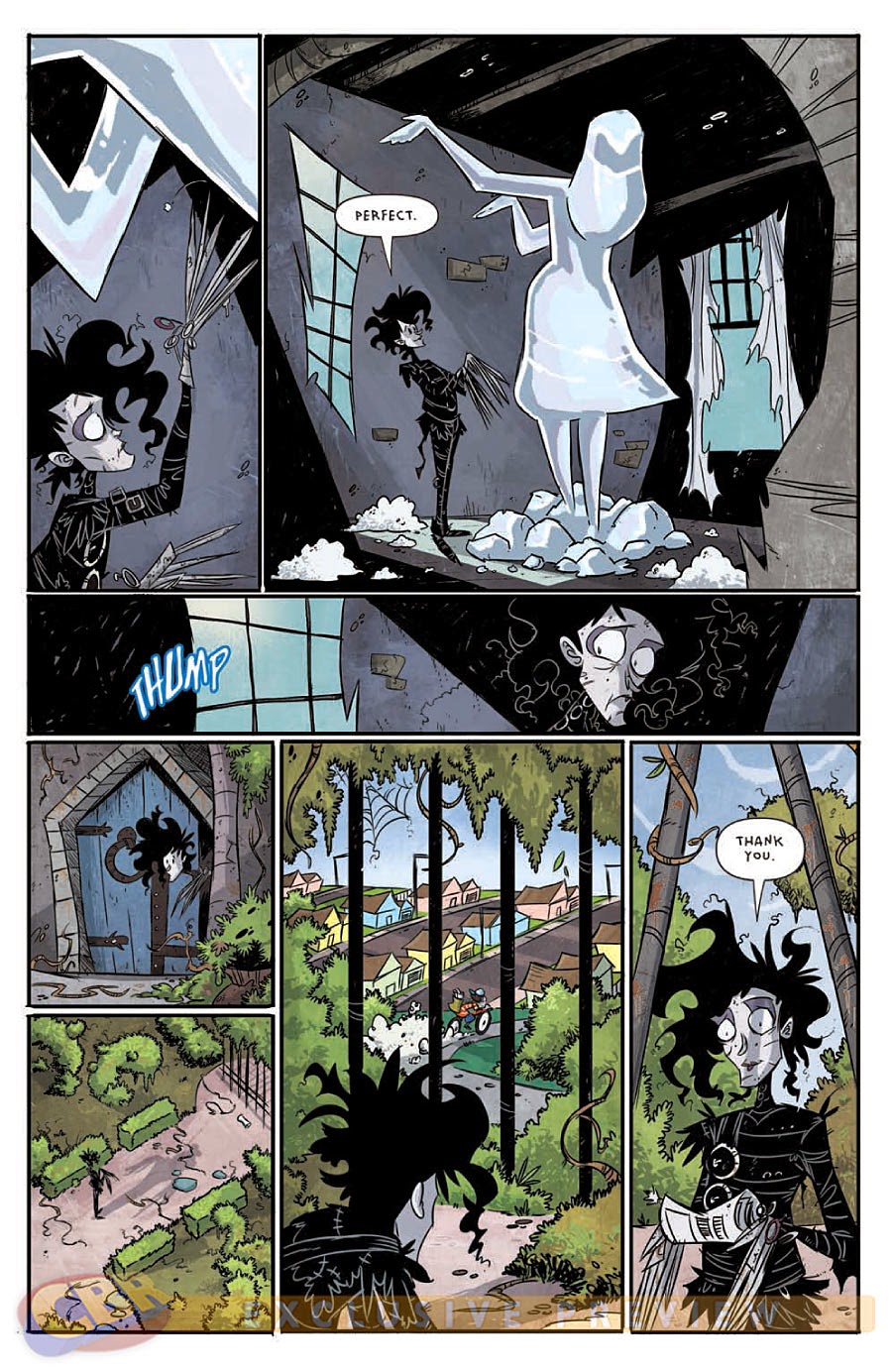
The only thing that felt contemporary to me about Edward Scissorhands #1 was the absence of any father figures in the narrative. That’s quite a common theme nowadays you know. Why? Simple really, the corporate state wants Father’s out of the home, replaced by Daddy State, who will control both Mum and Children with tax incentives, welfare and school/media propaganda from birth to grave.
But don’t children need a Dad in their lives? Doesn’t the lack of having a loving Father cause huge social, psychological, economic and societal problems? Yes, it does. But with any deliberately manufactured problem there’s a state sanctioned solution just waiting to clean up the mess. That’s what the illegal drugs, prisons, police and military are for. Some of the messed up children put on the uniforms of control, whilst others put on the uniform of prisoners. Abandoned children, now completely controlled by the corporate state. Why would the state want Fathers? Fathers mess things up, so they do all they can to get rid of them. But back to cuteville and old Edward Scissorhands.
I saw no sight or sound of the ubiquitous mobile devices that teenagers have glued to the sides of their heads these days, and there was no mention of any technology that didn’t exist when the movie came out in 1990. That was a bit odd as the book is set in the future, with the main protagonist being a teenage girl who was a baby in that movie. I know this will make me unpopular, but what I do on my blog is let you know exactly what I think about things, no self-censorship at all, just pure unadulterated truth from my mind straight onto the eternal void that is the Internet.
Do you know who Edward Scissorhands reminds me of? Edward Cullen from those dodgy Twilight movies, the eternally youthful old man who gets to hang out with teenage girls of every new generation. Creepy, isn’t it? But let’s not mention that, eh? It’s cute when creepy old guys with eternally youthful faces date jailbait schoolgirls. Isn’t it? If it’s a movie that made money that means it’s okay…….right???
Am I’m being a bit too harsh? Or am I just pointing out the sticky, uncomfortable truth? Because what happened in Twilight appears to be happening again in this comic. It’s a young looking old guy connected to young girls, and we’re supposed to find this cute and romantic? Not me mate.
In this book Edward Scissorhands is physically unchanged from over twenty-years ago, pottering around his Adams Family mansion being all cute and endearing. Whilst he is doing so a young schoolgirl is having Mom and school problems, her father is mentioned, but is physically absent, and so she is ripe for the pickings for cute old man Edward. That is a neon warning sign, and I would be engaging in wilful ignorance if I choose to ignore it.
But it’s supposed to be cute, and a woman writes it, and you’re looking too deeply into things. No I’m not. I’m just pointing out the reality of it all. That’s all I’m doing here. Let’s face it. Would you want Edward to be messing around with your school-age daughter? I bloody wouldn’t. I don’t care how cute it is. It’s just bloody weird, and wrong.
But this is a book about outsiders, I hear you complaining. Yeah, outsiders in 1990 mate, not real outsiders in 2014. The outsider in this book is not a cute (and young) Johnny Depp. He’s an old man living by himself who doesn't have any friends, and there is a young schoolgirl in the village who is obviously going to seek out and befriend him in future issues.
Is that cute?
Are you sure it’s cute?
Do you want to rethink that?
I’m not saying this is all deliberate. All I’m saying is that this is supposed to be teaching us lessons about bullying and being an outsider, but there’s something very iffy about it all. Iffy like the Twilight movies. Iffy in a way that makes me feel really uncomfortable with it all. This ain’t cute. It’s old man weird. Just uncomfortably, check Edward Scissorhand’s hard-drive weird.
Does my reaction say more about myself than the book itself? I don’t think so. I live in the UK, and one of the most famously ‘eccentric’ old men who we all grew up with on our television sets also had a thing for being lovably odd and befriending young girls with absent fathers. His name was Jimmy Saville. We knew him as Jim’ll fix it. He liked to fix things, just like Edward in this book. I’ll leave a link below.
Rating: 5/10 (Cute book with very creepy undertones)
Why was I reading a comic book about some bloke, his teenage ‘charge’ and her cute badger? Why was I reading what is ostensibly just another post apocalyptic, dystopic wasteland book? I wasn’t quite sure. There was something about the writing, something that I couldn’t quite put my finger on, until now.
Issue #3 has clarified a few things in my mind. I know why I’m reading the book now, and I’m glad that I let my subconscious mind guide my comic book reading choices.
This isn’t going to be a long review. I hate them, and who reads them anyway? There’s going to be nothing about the art here. There will be no analysis of the panel layout and narrative flow. I have something very simple to say, a quick point, and so I’ll make it and get out of here.
Creepy cults are common in comic books and action based narratives. You know how it goes, right? Charismatic leader, brainwashing, ridiculous ideas, end of world scenario, cult is bad.
There’s a ‘cult’ comic book out there at the moment that’s doing pretty decent business. That book is called ‘Sheltered, by Ed Brisson and Johnnie Christmas. It’s not a bad book, it’s okay, and it’s doing the cult thing quite well. The problem however is that it’s just another cult book, in a long line of cult books. The book is William Golding's Lord of the Flies, updated, somewhat, for the ‘Prepper’ generation. The main problem I have with ‘Sheltered’ is that the cult it chooses to demonise is a cult that is politically safe to do so. It’s a safe area, and because it’s safe it doesn’t really say anything. The biggest cult problem of our times is the cult of government worship, but comics don’t go there. Some cults must not be discussed.
Winterworld #3 introduces a cult that isn’t often acknowledged, at least in the neo-liberal mainstream media, as a cult at all. No, it’s not the cult of government worship, but it’s a good second best.
The cult that is being addressed here is the cult of man-made global warming believers.
I couldn’t believe it when I first read this. A 2014 comic book where the UN funded, Al Gore worshipping corporate man-made global warming fanatics are shown to be the deluded, nonsensical cult of gibbering, creepy morons that they actually are.
Chuck Dixon, thank you.
I have in my hands a comic book that appears to be mocking the corporate sponsored, anti-human, anti reality cult of man-made global warming. How did this get pass the liberal censors? Has anybody noticed this yet? I’m reading a ‘cult’ book where the cult is based on a real-life, ideology driven cult.
Wow.
Brilliant.
I knew there was something about this book, something that was keeping me reading. Now I know what it is. It’s the writer.
Chuck Dixon is a rare comic book writer who knows what is going on, and I’m so grateful that I’ve managed to find him. Somehow, subconsciously I’ve managed to stumble into something alive, something refreshingly honest in this age of corporate mainstream deception.
Winterwold is a book that is exposing a cult that actually needs exposing. This is what comic books should be doing, but so few of them actually are.
Thank you Chuck Dixon. Thank you for sticking your head above the parapet. Thank you for treading the less trodden path. Thank you for introducing real world ideas and concepts into the depressingly conformist and painfully politically correct neo-liberal world of 2014 comic books. This might start a new fad. Reality being addressed in comic books. That would be something new, and something worth exploring, don’t you think?