Showing posts with label Dynamite comics. Show all posts

Wednesday, 3 February 2016

Comic Review: Will Eisner's The Spirit #7- Butter your crumpets & put your feet up


Writer: Matt Wagner
Art: Dan Schkade
Colours: Brennan Wagner
Publisher: Dynamite Comics
Released: 20th January 2016


The Spirit #7 is very silly, and it’s not saying anything, or even trying to.

The Spirit himself is a daft, square jawed bloke in blue. He works for the ‘authorities,’ so it reinforces the idea that state authority is legitimate.

In other words, here’s another comic book character that anarchists will detest.

It’s set in a besuited gangster time with men wearing fedoras and where ‘criminal’ things are going on down the docks.

Matt Wagner won’t have done anything research for this one, as there’s nothing in here that would need any researching.

The fun to be had is with the silliness, and the art and the odd line of dialogue, or look from a character, that makes you smile.

It’s a child’s cartoon, and the art confirms that. It’s big, bright and colourful, and I enjoyed it.

The book offers readers a break from reality, in a land of silliness and cosy nostalgia for 1940’s noir Americana.

The Spirit #7 is as sharp as a butter knife. Read it with some toast, and a cup of coffee. Smile, enjoy, and then get back to reality.


Rating: 7/10 (Do you need a five-minute break from reality? Put your feet up, butter your crumpets and let the Spirit ease your troubled, exhausted, anxious, overburdened mind)


Wednesday, 3 June 2015

Comic Review: Justice Inc- The Avenger #1- You’re Awful, But I Like You


Writer: Mark Waid
Artist: Ronilson Freire
Publisher: Dynamite Comics
Released: 3rd June 2015


I shouldn’t like this comic book. It’s deliberately corny, very stupid and completely pointless, and the voice over narration that describes the unfolding action is straight out of that camp old Batman television show from the 1960’s.

Is it supposed to be a knowing, post-modern corny kitschy joke? Probably, but who is laughing?

Added to that corn factor is an ugly dollop of 2015 era social justice warrior political correctness. A woman who acts as a secretary isn’t a secretary at all. No, she’s a very rich and important woman because obviously having a young female secretary in the 1930’s (Is that when this book is set?) would be sexist, and we can’t have that, can we? I mean, women in the 1930’s never worked as secretaries did they? No, we can’t portray that in a comic book, because that is sexist, even though it is true.

Bugger reality, let’s all be politically correct and pretend that reality doesn’t exist.

<<<HUGE SIGH>>>

So what do we have here?

Yes, it’s just another comic book, desperate not to offend, very safe, and very depressing. The book should be chucked in the bin with all of the other inoffensive saying nothing junk that you’ll find in a comic book shop today, right?

Hang on, there’s a but.

There’s always a butt. Sorry, that’s a joke. Did it offend anybody? I hope so, anyway, the but is that something happens in this book that completely redeems it.

After an opening fight sequence that features the usual mix of cool quips and acrobatic women kicking men in the face, the narrative plods on and is uniformly awful, dull, laughable and pointless. But then, in one large panel, something is introduced, and yes it’s really, really stupid and meaningless as well, but (more butts) it somehow works.

I smiled, laughed even, and now I’m writing up this review not to say that the book is pointless and awful, but (I can’t escape the butts in this review) that it’s worthwhile after all.

I’m not even going to mention what this ‘thing’ is, because I don’t want to spoil it. I want it to be a nice surprise for everybody, so get the book, endure and wait for something that is genuinely cool, something that makes all of the awfulness worth enduring.

So, in summary, it’s an awful book, it says nothing, it doesn’t even try really, but you need to get yourself a copy of it immediately. Off you go, to the ebay, trust me, it’s not great, but it’s worth spending a couple of quid on.


Rating: 6.5/10 (Awful, but good)


Thursday, 14 May 2015

Comic Review: Reanimator #2- Busy, Silly & Fun


Writer: Keith Davidsen
Artist: Randy Valiente
Cover A: Francesco Francavilla
Cover B (Above): Andrew Mangum & Kyle Ritter
Publisher: Dynamite Comics
Released: 13th May 2015


Sometimes I need a break from all of the thinking, the endless drumming beat of neoliberalism that fascinates, but tires me out so much. I can’t spend all of my day obsessing over that stuff, it would drive me insane, and I’d be a gibbering wreck by the end of the week.

So, please forgive me here. I need to review a book about zombie girls in bikini’s and reanimated corpses, and Lovecraftian cults and swamp fighting and a mad scientist. A book that is set in a nowhere time, and isn’t really saying anything other than put your brain on sleep mode, forget your worries and let us take you on a daftly horrorific funfair ride.

Reanimator #2 is about a bored girl. She’s still grieving for her recently deceased boyfriend, and has an insatiable need for some adrenaline, for some excitement in her life, just to make here feel...something.

So, how to break that interminable boredom, the awful, belly aching pang of ennui that leaves you feeling empty and devoid of all hope?

How about a hoverboat ride through the everglades with a mad scientist doing mad scientist stuff, followed by a tussle with a zombie girl, a bracing swim in the alligator infested swamp, a meet and greet with a slightly silly cult leader, and a surprise twist to the end of the day that you’ll never, ever forget?

That all sounds pretty exciting to me, and although she might end up feeling a tad traumatised by the whole experience at least she can’t complain about feeling bored anymore.

The book has slightly wonky art, it’s a bit messy, but the story is a grand silly adventure and things are always happening, so you are never bored and the fast pace ensures that you are always looking forward to seeing what is going to happen next.

There’s a huge revelation at the end of this issue, so hopefully it hasn’t peaked too soon, but as a short boredom busting rest-stop between my more serious hard hitting political type books then Reanimator #2 was the perfect pit-stop.

The book gave me a fun ten minutes break, and now I’m back, re-energised and ready to get straight back into all of the serious, yet daunting, new world order, neoliberalism, statism, slavery, barking mad monkey at midnight banana curry insanity political nonsense. Thanks for the break lads. I needed it.


Rating: 7/10 (Busy, silly and fun)


Friday, 1 May 2015

Self-Censorship in Contemporary Comic Books- Review: Sherlock Holmes VS. Harry Houdini #5


Writers: Anthony Del Col & Conor McCreery
Artist: Carlos Furuzono
Main Cover Artist: Aaron Campbell
Variant Cover Artist: Colton Worley
Publisher: Dynamite Comics
Released: 22nd April 2015


*NOTE: THIS REVIEW FEATURES MY LIST OF NEO-LIBERAL POLITICALLY EXPEDIENT COMIC BOOK HEROES AND VILLAINS


By far and away the best aspect about this entire Holmes Vs Houdini series has been the awesome front covers. The plot of the book itself stopped interesting me a while back, and in this final issue it has devolved into some daft, but at least highly contemporary anti-Russian fear propaganda.

Variant cover by Colton Worley
Don’t get upset, don’t start chucking the dreaded ‘conspiracy’ label at me either, because I’m not saying that this book is some kind of devious US government funded anti-Russian operation. It isn’t. It’s a book written by a bloke who needed a convenient villain, and the easy villain at the moment is Russia, so that’s where he has gone with the story.

What do I mean by ‘convenient’ villain? I mean that if you use a Russian villain in your book nobody is going to get upset about it. Heck, nobody will even mention it, well except for blokes like me on my blog.

I won’t go on too much about contemporary geo-political events, but Russia is starting to be demonised and given their cold war era ‘enemy of freedom’ status in the mainstream media once again in 2015. What is portrayed in the corporate mainstream media (as they are the great arbitrators of reality, right?) often trickles down into other forms of popular media as well, such as WWE wrestling, and comic books. So if the evil Russians are the villains on the (fake) news, why not use them as the fake bad guys in comic books as well?

If Russia is the convenient or expedient villain in 2015 who are the people/countries that comic book writers will not use as villains? Interesting question, don’t you think? People might not like to hear this, but in the western world at the moment we are living in the times of neo-liberal political correctness. You can criticise some people, but if you criticise others then it’s CAREER OVER.

Here are the main groupings (in my opinion, and based on my reading of hundreds of comic books over the past decade) of people who you are NOT allowed to criticise.

Non whites. (If there is a tint in their skin, don’t go there)
Homosexuals.
Immigrants (Any criticism of mass immigration will lead to accusations of racism).
Muslims.
Jews.
Feminists.
Social justice warrior campaigners.
The armed forces.
The Police.
China.
Saudi Arabia (and all of the other Gulf dictatorships supported by the west).
Israel.
Democratically elected (selected, in reality) Governments.

I’ve missed a few, obviously, but I think that’s a pretty good starting list. If you are not allowed to criticise any of the above groups of people, who are the groups of people that you are allowed, or even encouraged to criticise in our politically correct neo-liberal times?

The following list is the neo-liberal politically correct go to people that you ARE allowed to use as villains in 2015 comic books. Again, this list is based on my own experiences of reading comic books over the past decade.

White men.
Gun owners.
Survivalists/Preppers.
Southern Americans (always portrayed as redneck racists).
Nazi’s.
North Koreans.
Dictators (Not those supported by the west obviously)
Russians.
Homophobes.
Racists.
Misogynists.
Christians.
Aliens.
Truthers (The 9/11 truth people and anybody who questions government/media lies).

There are rare exceptions, when individuals in one of the two groups are shown to be heroic or villainous, but when this happens that person is not held as a representative of the group as a whole. You’ll get a crooked cop, but there’s always a good cop to defeat him and make sure that the organisation as a whole is not denigrated. You’ll get a nice Christian, but most Christians are still presented as crazy cult followers, and if you are looking for an evil Muslim or a crazy feminist character (they do exist in reality you know) then contemporary neo-liberal comic books are not going to be for you.

So looking at my two little lists, put yourself in the role of a comic book writer. You need a villain, so who is it going to be? You can’t use real life villains such as Islamic terrorists, or murderous cops, so what do you do instead? Easy, you pick a Russian or a Nazi, or a racist white man, or a Christian cult leader, or an alien and you make the story about personalities and exciting plot twists. You avoid the real issues of our times, and steer clear of all of the controversies that will get you in trouble with the neo-liberal politically correct thought Police that will call you bigoted or racist if you dare to go up against them.

Sherlock Holmes VS. Harry Hoodini uses a Russian villain, good old faithful mad monk Rasputin, and creates a safe scenario where the US (represented by Houdini) and the UK (represented by Holmes) team up to beat the evil red threat. You can do that, you are allowed to do that, nobody will mind, and you’ll have comic book fans putting up reviews that talk about the art, the plot and how exciting it all was, or whether or not it all made sense, or surprised, or entertained them.

To me it was just another comic. It messed up a bit after the second issue, and played a bit loose with the detective formula, but from that point on it kind of cruised to the end. The villain lost, his motive was hate, nothing deeper than that, don’t think too much about it, as it’s not important. All you need to know is that it was a fun ride and the heroes won, end of story, or is it?

I didn’t hate the book, but it wasn’t really doing anything. It’s not going to linger long in my memory, but nobody was offended, the covers looked great, and I’m sure that Holmes and Houdini will return. The characters are cheap, available, easy and safe and they have name value that is guaranteed to gain you at least a little bit of interest. I don’t blame Dynamite Comics for using them. If I wanted to sell a few hundred comic books then I’d probably do the same thing myself.

I’ll finish off this review with a quick message to writers Anthony Del Col and Conor McCreery.

I wasn’t that impressed with the content of the book, but no hard feelings lads. I enjoyed the covers, and they are going to look great on my bedroom wall. Best of luck with all future projects, but go on, take a chance. Say something that you are not allowed to say. Be brave. It will be fun.


Rating: 6/10 (Lots of action and last second surprises and twists in this final issue, but the story didn’t say anything, other than to remind readers that it’s still politically expedient to have Russian villains in contemporary comic books)


 Please let me know if you agree or disagree with my list. Did I miss any group out? Who do you think you are allowed to criticise, and who do you think that you are not allowed to criticise in contemporary comic books?


Saturday, 18 April 2015

Comic Review: Reanimator #1- So much more than just another awesome Francavilla B Cover


Writer: Keith Davidsen
Artist: Randy Valiente
Cover B: Francesco Francavilla
Publisher: Dynamite Comics
Released: 8th April 2015


I’ve just read a comic book that I really enjoyed, and I want to say some nice things about it and thank everybody involved, so here goes:

I only bought Reanimator #1 because of the typically awesome Francavilla front cover. I read the preview and it didn’t appeal, but when I saw that cover in my comic book store I decided to take a chance on the book. After all, if it turned out to be terrible then at least I’d have a great looking cover for my money.

So what’s the book all about? That’s the problem really. It sounds pretty formulaic on the surface. It’s about a Dr. Frankenstein type, and it has elements of magic and Lovecraftian horror mythology in it as well. The main protagonist is a girl, a scientist, and she’s pretty.

See what I mean?

Sounds unoriginal and uninspired doesn’t it? The strange thing however is that the book is actually a lot of fun and offers a lot more than you might think. The Dr. Frankenstein character is odd, but oddly likeable as well. The magic and Lovecraftian thematic meat of the narrative is interesting because it’s mixed in with elements of contemporary science, new-age ideas and street/thug life. Plus the girl protagonist is believably human and nowhere near as generic or annoying as your usual strong independent female warrior comic book type in 2015. She’s unfulfilled, bored, middle class and stuck in a safe career rut. She is doing daft things and taking unnecessary risks just to inject some much needed drama and sense of danger into the empty routine and meaning free existence in which she has found herself living in.

I read her and I can believe that she exists because she is bored, she has flaws, and she is lonely. In other words, she comes across like a real life flesh and blood human being, and reading that type of character in a comic book is something that really stands out. It shouldn’t. Fictional characters should always feel at least somewhat real, but the fact of the matter is that they don’t, so when you read one that is well written and believable she stands out like a (depressingly rare) truth told on a mainstream television ‘programme.’

The narrative flow of the book is fast, eventful, and fun, and features a final page reveal that makes a lot of sense, bridging the gap between contrivance for the sake of drama and creating a believable scenario that connects the main two protagonists. Did that make sense? Probably not. What I am trying to say is that the writing is good, very good.

The art (which I often neglect to talk about in my reviews) is easy on the eye, and that’s not just a cliché that I’m throwing in here because I don’t know what else to say about it. It’s clear, precise, uncluttered, and easy to follow and exists as good art should exist in a comic book, acting as the perfect companion to an interesting story, servicing that story rather than distracting from it.

Hopefully I’ve convinced everybody reading this review that Reanimator #1 is a comic book that is worth taking a chance on. It’s more than just the awesome Cover B from Francesco Francavilla. That cover is an excellent starter, but the main course of the book itself is just as delicious as well, and I’m happy to recommend it here on my occasionally daft, occasionally pompous, occasionally preachy, occasionally po-faced and serious, but always honest blog.


Rating: 8/10 (A fun filled horror comic book)


Friday, 30 January 2015

Comic book reviews: Justice Inc #6 & Winterworld #7- ‘Policedar’ special


The following two reviews are ‘Policedar’ reviews. That is a term invented by myself, and invented just one minute ago. A ‘Policedar’ review is a review that will expose any subtle Police state message that is hiding within an entertainment (music/television/movie/comic book) text. I don’t hate the Police, but you have to understand the reality that the Police are always the actual, physical, flesh and blood people who enact new world order/globalist policies that enslave us all. The order following boys and girls in uniform create the global Police state, not the be-suited politicians and the shadowy cabals that operate behind the scenes to manipulate society. It’s the Police who actually build the prison, so ‘Policedar’ is the word that I will be using, and yes, it’s a take on the word ‘Gaydar,’ a word very much in the popular vernacular right now. These reviews will briefly discuss the artwork, narrative and other aspects of the text, but their main concerns will be any Police state issues within that text.


Policedar review no 1- Justice Inc #6 (Dynamite Comics)

This book concludes the end of a very confusing run where month by month it was almost impossible to understand what was going on. The script was incredibly convoluted with far too many characters and organisational names and time travel shenanigans going on, and if you read it on a monthly basis without reference to the previous books then you would be hopelessly lost and confused with what was happening. This is annoying, very annoying, and so I’m not going to miss the book. The art was a bit static, and the characters (apart from The Shadow) blended into each other far too much, making it even more confusing.

The villains were the Nazi’s, and the heroes were independent, wealthy men. This ties into the myth that the rich are there to help the poor innocent, helpless civilian-suspects, and that capitalism is your friend, not your enemy, so in that sense it’s an old fashioned, right-leaning book, not one for the Collectivist, Socialist, Marxists who tend to write most of the mainstream comic books these days. One thing to note is that despite it being a time travel book the latest event that it dealt with was one small panel of the exploding towers on 9/11. Nothing post that event in 2001 (that is over thirteen years ago now) was discussed. In that sense it was another book playing it very, very safe and making sure that it didn’t do anything to upset the current corporate/banking/permanent war status quo of the elite’s that control the political system and mainstream media in 2015. I enjoyed the cover-art, and I appreciated that the Shadow was singled out as the most interesting character in the book, but the plot as a whole was far too intricate, it didn’t deal with contemporary concerns, and it left very little impact on me as a whole. Rating: 3/10


Policed review no 2- WinterWorld #7 (IDW Comics)

This book comes from the ‘right-wing’ point of view, as far as socio-political commentary goes, but it focuses on independent ‘normal’ people rather than rich industrialists like Bruce Wayne, Tony Stark or all of the heroes in Justice Inc. The main protagonists don’t rely on the state, and they are not a part of the corporate status quo/control system because in this post-apocalyptic freezing cold world there is no state, and no corporate elite’s to belong to. I classify them as ‘right-wing’ because they are independent people who do not belong, and do not want to join a collectivist/leftist commune of deluded Animal farm hippie types. They are tough, self-sufficient, independent and free, and that is why I like them.

This issue is the end of a run, and the last time we’ll see the amazing artwork of artist Tomas Giorello on the title. The title returns in February and March 2015 with two prequel books that feature the main two protagonist’s early days, before they met, and before Winterworld became what it is today. Hopefully they won’t be as bad as those never to be mentioned Star Wars prequels, because this has been a good book, with strong male and female characters, and no Police state nonsense to spoil it all. This issue featured a fight, a team-up, and the action will continue. It was good, the message of independence and self-sufficiency was just what we need to see more of in comics, and the art, by the wonderfully talented Mr Giorello was fantastic. If I see the name ‘Chuck Dixon’ on a title I’ll buy the book, not because I know that he’ll write fascinating characters and a well crafted, exciting story, but because he doesn’t do the feminist liberal nonsense that has contaminated most of the other comic book writers working in the industry today. Rating: 8/10


Monday, 26 January 2015

Comic review: Twilight Zone- Shadow & Substance #1- Losing is the new winning


Writer: Mark Rahner
Artist: Edu Menna
Publisher: Dynamite
Released: 21st January 2015


If you could go back in time and meet yourself as a child would you stop yourself from doing something stupid that made you what you are today?

Here’s a different way of asking that same question. Would you go back in time to stop yourself from experiencing something that totally and utterly sucked? I certainly would. Suffering sucks, sod all that learning from the experience bullshit. Sometimes, actually most of the times, it just plain sucks when something bad happens to you. Sod the lessons. I’d rather read about them in a book.

Yeah, I know how the argument goes. What if the sucky incident was something that you needed to learn in order to progress and develop on an intellectual, emotional or spiritual level? You know what? Lots of horrible things have happened to me in my life, and the vast, vast majority of them taught me absolutely nothing that I didn’t already know.

Sometimes horrible things happen, and they are completely meaningless. You learn nothing, other than life can be really, really horrible, that people act in ways that make you hate the human race, and that nobody gives a crap about you, at all. 

The only thing to be learnt is that you better dust yourself off and continue, because if you don’t, you’ll die, and nobody is going to give a shit when you do, just the poor saps that have to dispose of your useless, miserable, messed-up carcass. That’s life, that’s the lesson, and if you don’t already understand it after a couple of weeks at school then you’re a very dense individual who will probably spend the rest of his life learning absolutely nothing.

The plot of this particular comic book is posing that hoary old Twilight Zone conundrum, what would you do if you met yourself as a child? Would you stop yourself from doing something stupid that made you the man you are today, or would you do nothing, because the younger version of yourself needs to learn from the horrible experience? You already know my answer to that one. Yes, of course I bloody would do something about it. I’d help my younger self as much as possible. God knows the poor bugger needed some help, and he certainly didn’t get any at the time.

Having said that, there is a major difference between my own life and the character in this book. He’s a successful writer, and I’m a twit writing on a blog. He might be a self-hating alcoholic mess, but he’s a successful, self-hating, alcoholic mess. He gets to do book signings whilst I get to write comic book reviews that are read by a couple of people who accidentally click on my blog.

Am I bitter? Yes, very much so, but at least I don’t have to sit embarrassingly by myself for a couple of hours whilst people mess around on their phones and ignore me. This actually happened to some ‘writers’ doing a book signing in my local bookshop last week, the poor sods. People seriously need to get the hell off their iphones and start reading again if they want to reverse the deliberate dumbing down of our entire species, but that’s another rant for another occasion.

Anyway, back to the book. What do you reckon he should do? Interfere or leave it alone? Should he save his younger self from some self-inflicted misery, because we all know what’s going to happen if he does, right? My guess is that it’ll change his future, and rather than being a successful writer he’ll be some twit writing on an Internet blog. He’ll probably end up writing comic book reviews, or something else that screams loser from every pore and orifice of the body. So what is it going to be? Success, self-hatred and a drinking problem, or failure, happiness, self-respect and a blog about comic books?

Here’s the part of my review where I talk about the actual construction of the comic, and not just the themes, ideas, and all of that other stuff that I’m interested in. Okay, here I go:

The art is a bit shoddy, and the panel layout is occasionally annoying and confusing, but as the story is so simple those problems are easily surmounted, even though reading the book is a far from smooth experience.

The plot contains two contemporary references (about mobile phones/surveillance devices) and the rest of it could have been set in your usual Twilight Zone era of the 1970’s. The main protagonist is two
dimensional, even though we get to see him as a kid, and he’s not exactly very likeable either.

The book succeeds because the original idea is interesting, and not because of the actual realisation of that idea in the comic book itself. I’ll be purchasing the next issue, not because of the art, or the characters, but because of that original idea. Sometimes a good idea is all that you need, and despite all of it’s flaws they have themselves a repeat customer here.

Now back to my blog, back to my unsuccessfully happy life, and back to daydreaming about poorly attended book-signings, girl-friend problems and missed AA meetings. Keep your success. Losers are the new winners. Well, it feels that way to this guy anyway, but what do I know?

Rating: 6/10

Wednesday, 14 January 2015

Comic review: Sherlock Holmes Vs. Harry Houdini #3- Great cover, borderline unreadable book.


Writers: Anthony Del Col & Conor McCreery
Artist: Carlos Furuzono
Cover artist: Aaron Campbell
Publisher: Dynamite Comics
Released: 14th January 2015

****SPOILERS IN REVIEW****


As soon as I finish up this review I’m going to scour the Internet for the opinion of other reviewers. There must be somebody out there that likes this comic book, but to me it reads like a baffling, haphazard, sprawling, headache inducing, confusing mess.

I want to clarify that statement, and make it crystal clear that my confusion has nothing to do with the narrative itself. I understand exactly what is going on. I have re-read the book twice over, and even gone back to issue #2 to clarify a few points in my mind, so I know exactly what is happening. My confusion is based on the construction of the story and what it is trying to do to the poor reader.

If it’s trying to baffle, trying to confound, trying to annoy the reader, then it’s a huge success. This is dense, dense stuff. It doesn’t help that the two lead characters are drawn so similarly either. Was that Holmes speaking, or was it Houdini? I kept getting them mixed up as they are almost identical in appearance. The final panel illustrates this problem perfectly, with the two leads sharing the panel, looking like twins, and ending the book with the same sense of conclusion that it opened with. Was that Houdini on the hypnotist’s couch? Let me check again.

Nope, it was Holmes.

And the plot itself, underneath all of the dense layers of obsuration it’s maddeningly nonsensical and utterly unlike any detective story that I’ve ever read.

Issue #2 concluding by revealing the identity of the villain. It also revealed his motivations, and exactly how he was carrying out his machinations. You don’t do this in a detective story, and if you do then you better have a pretty bloody good reason for doing so.

Issue #3 of Sherlock Holmes vs. Houdini looks at the villain’s accomplice/boss, at the bloke in the shadows who was helping him out. This bloke turns out to be ****SPOILER ALERT***** Rasputin the mad monk. Yeah, that guy….again. So why the early reveal? I don’t see any good reason here, as the reveal isn’t a narrative misdirection, designed to thrill the reader, it’s just that the main villain wasn’t the dull old guy after all, rather he was Rasputin instead. So what? Why exactly am I supposed to care about this?

So Rasputin is messing with Holmes and Houdini with his special magical powers, and when confronted by Holmes the great detective doesn’t even care to ‘wait for the reveal.’ Rather than chatting it over with the beardy weirdo he chooses instead to physically attack Rasputin. When does that ever happen in a Holmes story? The answer to that question is, never. It never happens because Sherlock Holmes is a brain, a puzzle solver, not a fist first, explanation later kind of guy, as he is portrayed in this book. The only thing that would interest Holmes at all about this case would be the motive of the villain, so to have him refusing an explanation is utterly baffling to me.

I tell you what, thinking about this again, I know exactly how Holmes feels. If I was in his shoes then I don’t think I’d care much about the reveal either. The reason why I don’t care is because the writer hasn’t given me any reason to care. There’s no mystery here, just an explanation of motive. That isn’t a detective story, and it’s barely a story at all.

I’m a huge fan of the original Sherlock Holmes stories, but this interpretation of Holmes portrays him as somebody that I find impossible to have any empathy for, and Harry Houdini is just as unpleasant, arrogant, petty and self centred as well. Why create a comic book where your titular characters are egotistical braggarts who readers are going to have a difficult time identifying with? That’s a baffling decision, and I can’t understand why it was made.

Why should anybody care that two arrogant sods are being messed with? I don’t like either character in this book, and all the story has to offer now is to reveal why Rasputin was messing with them, and whether or not he has any genuine supernatural powers. That’s not enough to keep the story interesting. I need more than that to keep on reading.

This issue ends with Rasputin doing what Rasputin always does in stories such as this ***SPOILER ALERT AGAIN**** he dies, then comes back to life again. Am I supposed to care about him now? Why should I care? I don’t understand why I should care.

Oh, and I see in the preview for issue #4 that Houdini supposedly got arrested in this book. Err, what? Did I miss that? Nope, I didn’t. What was missing was the panel that actually showed him getting arrested. That panel never existed. Goddamn it, this review is starting to make my head hurt now.

This book has been such a slog to get through, such bloody hard work, not a lot of fun, and I can’t find any valid reason to care about any of it.

I need some positives here, as all of this negativity is starting to weigh me down. There is one good thing about the book, that being the exceptional front cover art by Aaron Campbell. Look at that cover again at the top of this review. Isn’t that beautiful? Mr Campbell has done a great job on that one.

Oh man, here we go again with more depressing negativity, but I have to be truthful here. That amazing front cover art is in a different league to the artwork within the actual book, and the drowning scene that is featured on that cover never even happens in the story anyway. There is a tank of water in the book, but there’s no girl in it, so I don’t know what happened there. It’s like the cover art is from another, much better book than this one. That cover is great, but the interior stuff is not very impressive at all.

I can’t keep buying this book because of the cover, no matter how good it is. I need something more than that for my money, and the story and art within just isn’t cutting it for me, so off I go.

Now to read those other reviews. I’m sure that somebody out there has given this book a good rating (there always seems to be somebody on the Internet who will give a top mark to a bad book) and I can’t wait to see how he talks this one up.

Rating: 2/10 (for that lovely front cover)


Wednesday, 12 November 2014

Comic review: Sherlock Holmes Vs. Harry Houdini #2: Breaking from the tried and tested formula


Writers: Anthony Del Col & Conor McCreery
Artist: Carlos Furuzono
Publisher: Dynamite Comics
Released: 12th November 2014


***Warning!! Plot spoiler in review***

The majority of this book is taken up with action/buddy movie panels of Houdini and Holmes trying to outdo each other, only to fall into inevitable mutual respect. You know how that routine works right? We’ve seen it so, so many times before. It’s not original, it’s a formula, but it’s okay, it’s kind of fun.

The rest of the book is a murder mystery tale with a final reveal that probably gives away a bit too much of the plot, leaving you with the unsatisfying feeling that you have already solved the mystery before the great detective.

Mystery/detective books aren’t supposed to work like that. You are supposed to hook the reader by dragging out the reveal until the end of the book. That's how it works, that's how it always works.

But not here.

The very obvious enjoyment to be had in reading what can loosely be described as the ‘murder mystery’ genre is to try to guess who did it, with the writer dropping clues throughout, but with these clues only making sense come the final reveal.

That’s exactly what happens in every single Sherlock Holmes story written by Sir Arthur Conan Doyle, and that's what makes them so much fun to read. Holmes is the great detective, so naturally it is (usually) him who delivers the final denouement at the conclusion to the mystery narrative, but can you uncover the mystery before he reveals it? That's the hook that keeps you reading, that keeps you on the look-out for the clue that will unlock the puzzle, and that's why it is so enjoyable.

Why writers Anthony Del Col and Conor McCreery are breaking from this formula so early on in the story (it’s only issue #2) is the biggest mystery of the book so far.

Hopefully there’s something else going on in this story, because if this is just a plot about a wronged rival trying to cause Houdini some irreparable career problems then, well, that isn’t exactly a lot of fun, is it? Plus we know Houdini’s real-life story already, and his career went pretty well throughout his entire life.

What we are left with is a buddy movie, in comic book form. That’s okay, but I need something a bit more than that in my comic books.  I’ll give this book one more issue, see if it offers anything else, but if it doesn't then I’ll have to give it up. The art is only average, and although I like the alternative covers that isn’t enough reason for me to hang on until the end of the story. I ain’t rich you know, and I have a growing chocolate and fragrance addiction that needs feeding. Keep the reveal to the end. Giving it to us already in issue #2 is a very strange thing to do, hopefully it makes sense in issue #3, but at the moment I don't understand that decision at all.

Rating: 5/10

Friday, 24 October 2014

Blitz review: Justice Inc #3- A good way to learn about 1930’s ‘Pulp’ history


Writer: Michael Uslan
Artist: Giovanni Timpano
Publisher: Dynamite Comics
Released: October 22nd 2014


If you can get over the fact that all of the heroes in Justice Inc are establishment authority figures, thus legitimising the statist/corporate status quo, and if you can also put up with the narrative being largely based in Tibet, that safe comic book home of faux-western spirituality, then there’s some enjoyment to be had in this series.

The characters themselves, although corporate authority figures, are interesting because they are being developed as if they were brand new. The book has little contemporary relevance, but as an enjoyable diversion, and as a way to discover comic book heroes that were big time stars before the current age of Batman, Spiderman and the Avengers, it’s definitely worth checking out.

Issue #3 develops all three main characters, and we even see the birth of one of them, and an explanation of his new powers. The writing has some thought behind it as well. It’s book-ended with one paragraph of context explanation of the narrative so far, and ends with a few pages where writer Michael Uslan explains some of the references made within the story. That’s very reader friendly, and I give him huge credit for that.

You’ll be particularly interested in this book if you want to learn more about the comic book heroes of the 1930’s days of pulp, and Orson Welles on the radio. For that reason alone it’s more interesting than the majority of irrelevant comic books that are on the market today.

The art is fine, not great, but okay, the story has been well researched, and the characters are interesting as well. It’s nothing spectacular, nothing revolutionary, or even that thought provoking, but it’s enjoyable, and as a ten-minute comic book that doesn’t insult my intelligence too much I’m giving it a thumbs up as a good short dose of silly, learn about the history of comic books fun.

Rating: 7/10

Thursday, 2 October 2014

Sherlock Holmes vs. Harry Houdini #1


Writers: Anthony Del Col & Conor McCreery
Artist: Carlos Furuzono
Publisher: Dynamite Comics
Released: 1st October 2014


Sherlock Holmes and Harry Houdini have a lot in common. Yes, I know that one of them is fictional, but the two characters in a literary sense occupy a very similar landscape. When you visualise the two personalities you get Victorian era London, spiritualism, fake mediums, daring escapes and the unravelling of mysteries.

Sherlock Holmes didn’t have much time for the supernatural. He thought it all a load of old bunk, a trick designed to part the gullible with their money. Harry Houdini was a well known, outspoken critic of the spiritual fakers and charlatans of his time, publicly denouncing them as frauds. He never claimed to be supernatural, like a lot of stage magicians of his time. He kept his secrets, but he didn’t claim to escape his chains because of magical powers. He did physical tricks, and he did them very well, and with a lot of showmanship.

Therefore the teaming up of Sherlock Holmes and Harry Houdini seems completely logical, as their attitudes towards the supernatural are pretty much identical. The problem however, was how do you write a ‘versus’ story when the two characters would essentially agree with each other?

Writers Anthony Del Col and Conor McCreery aren’t pulling a fast one here by having a versus title, and then doing the opposite in the book. I admire that honesty. The book opens with the two personalities engaging in a versus battle, with Holmes declaring that he can deduce how Houdini performs all of his famous escapes.

Houdini takes him up on the challenge, and this book follows the two larger than life personalities as they engage in a public battle of one-upmanship live on a London stage. The book closes with a third party taking the role of the villain of the piece, a villain that will force the two personalities to team up and explore the possibility that certain elements of the paranormal are dangerously real, and not just the smoke and mirrors con trick that they had both previously assumed it to be.

This book is a lot of fun, and that’s exactly what you want from a title with two huge personalities like Sherlock Holmes and Harry Houdini. Houdini is written as a sceptical, big headed guy with a more down to earth wife who helps him to stay grounded. Holmes is written as a sceptical, big headed guy with Doctor Watson helping him to stay grounded. The two personalities are almost identical, so when they meet there is a fantastic dynamic going on with them trying to best each other.

The dialogue flows very well and the two characters are portrayed both on, and off stage, giving the reader a satisfying contrast between their public and private personas. This simple script technique is very reader friendly, making you feel like you are getting the real inside story on two extremely interesting personalities.

The only problem I had with the book was that Holmes himself is pencilled as a square jawed, beefy American movie star type, rather than as the hawked nosed, rake thin scholar that I usually associate with the character. That’s a minor snipe though, as the art is perfectly fine, with some lovely usage of shading and shadow, and with a nice use of dark backgrounds to create a spooky atmosphere for the book.

Sherlock Holmes vs. Harry Houdini #1 is a very well written book with two fascinating characters coming together to create a special a piece of comic book magic. It’s very well paced, starting off with a public confrontation between Holmes and Houdini; it then further develops the two characters, before concluding with a dramatic scene involving the villain of the piece. You'll love this book. It really is a lot of fun. The title might seem a bit daft, but it’s a very entertaining, well-structured comic book about two personalities that have a lot more in common than I had previously realised.

Rating: 9/10

Wednesday, 24 September 2014

Comic book review: Justice Inc #2- The Avenger is old and new, whilst Batman is just old, and old


Writer: Michael Uslan
Artist: Giovanni Timpano
Publisher: Dynamite Comics
Released: 24th September 2014


I’m reading this book for The Shadow, and if the other two characters bring anything to the table then that’s just a bonus. Issue #2 gave me some interesting insights into the character, personality and special abilities of The Shadow, so that alone is reason enough for me to both enjoy and appreciate the book.

Okay, so the art isn’t that special. There’s a lack of atmosphere in the shading, and the colouring is far too pastel and bright for my liking. But again, going back to The Shadow, he’s drawn exactly like The Shadow should be drawn, so that’s enough for me.

The story in issue #2 of Justice Inc is brief, as it should be in an issue #2. Most of the action takes place in-flight, with the character that will become ‘The Avenger’ going through his Bruce Wayne moment of horror that will come to define his subsequent crime-fighting career. The dialogue, again as it was in the first issue, is very amusing, but amusing without being silly and ridiculous as you’ll find in the dialogue of far too many mainstream comic books today. Oh, and there was a hint of a femme-fatale in this book, and I’m perfectly happy with that as every old fashioned pulp book needs a sexy bad femme-fatale to spice things up a bit.

Far too many comic books and comic book writers of today are stuck in the 1990’s, and are either unwilling or unable to negotiate the post 9/11 world that we are all living in today. Plus, the mainstream obsession with political correctness and it’s diversionary issues to do with race, gender and sexuality is depressing beyond belief, and makes most of the books put out by DC and Marvel today unreadable for any educated and awakened mind.  Justice Inc is not stuck in the 1990’s, and so far I detect no hint of Rockefeller funded liberalism in the book. Whilst Marvel stays in the 1990’s, trying to get attention by playing out tired old race and gender issues, Justice Inc is bypassing 1970’s feminism altogether by going back to the pulp days of the late 1930’s and 1940’s. It’s using the old heroes and personalities of that period, putting them all in the proverbial blender and having a good old time with the results of that delicious mix.

However, you must bear in mind that if you decide to take a chance on Justice Inc you’re going to get a story that is in no way contemporaneous with current geo-political events. This is a book set in the safe past with characters like Einstein and Howard Hughes, very well known historical figures that are uncontroversial, safe and easy to play around with in a comic book. It’s not a brave book. It’s a comic book that has taken elements of the pulp history of the comic book genre and decided to play out the old stories once again, but for a new audience. These are pulp heroes of the 1940's and that’s where their playground is, not a post 9/11 world, the world that we are all living in today.

If the majority of comic books available today were stuck in the 1940’s it would drive me absolutely nuts. I’m sure they’d be preferable to the liberal nonsense that dominates DC and Marvel today, but I’d still hate it, and every week on this blog I’d be calling them out on their inability to reflect the world of 2014. I give Dynamite comics a pass on this book for a couple of reasons. Firstly, I’m a huge fan of the Shadow, and anything with The Shadow in it is fine by me. Sure I’d like him to be brought into this NSA spying/criminal banks/ puppet politician’s era, but there’s something about his character that appeals to me. It’s probably because he’s independent, morally upright and utterly ruthless with criminal lowlifes. Secondly, this delving back into the 1940’s is interesting because it’s only being done in these Shadow books. I know it’s safe and easy, but at the moment it’s a nice change from the norm, and anything that breaks from the norm at the moment has to be good.

Setting aside my Shadow fandom for a moment, Justice Inc #2 is worth investing your time and money in because you are seeing the re-birth of a super hero known as The Avenger. That’s interesting as The Avenger is a character that has not yet been done to death. He’s an old character, but somewhat of a lost one, somebody who from what I’ve researched appears to be very interesting, and I welcome his reintroduction into the comic book world of today. Contrast that to the character of Batman who gets his origin story redone every couple of years or so in DC comics. Heck, the story is even being redone on mainstream television at the moment in a show called ‘Gotham.’ The Avenger is old, but new. Batman is just old, and old. Get the book because of the re-birth of The Avenger, that alone is good enough a reason to read it, but if like myself you are a huge fan of the awesomeness that is The Shadow, you’ll want to pick this book up as well.

Rating: 7/10

Thursday, 11 September 2014

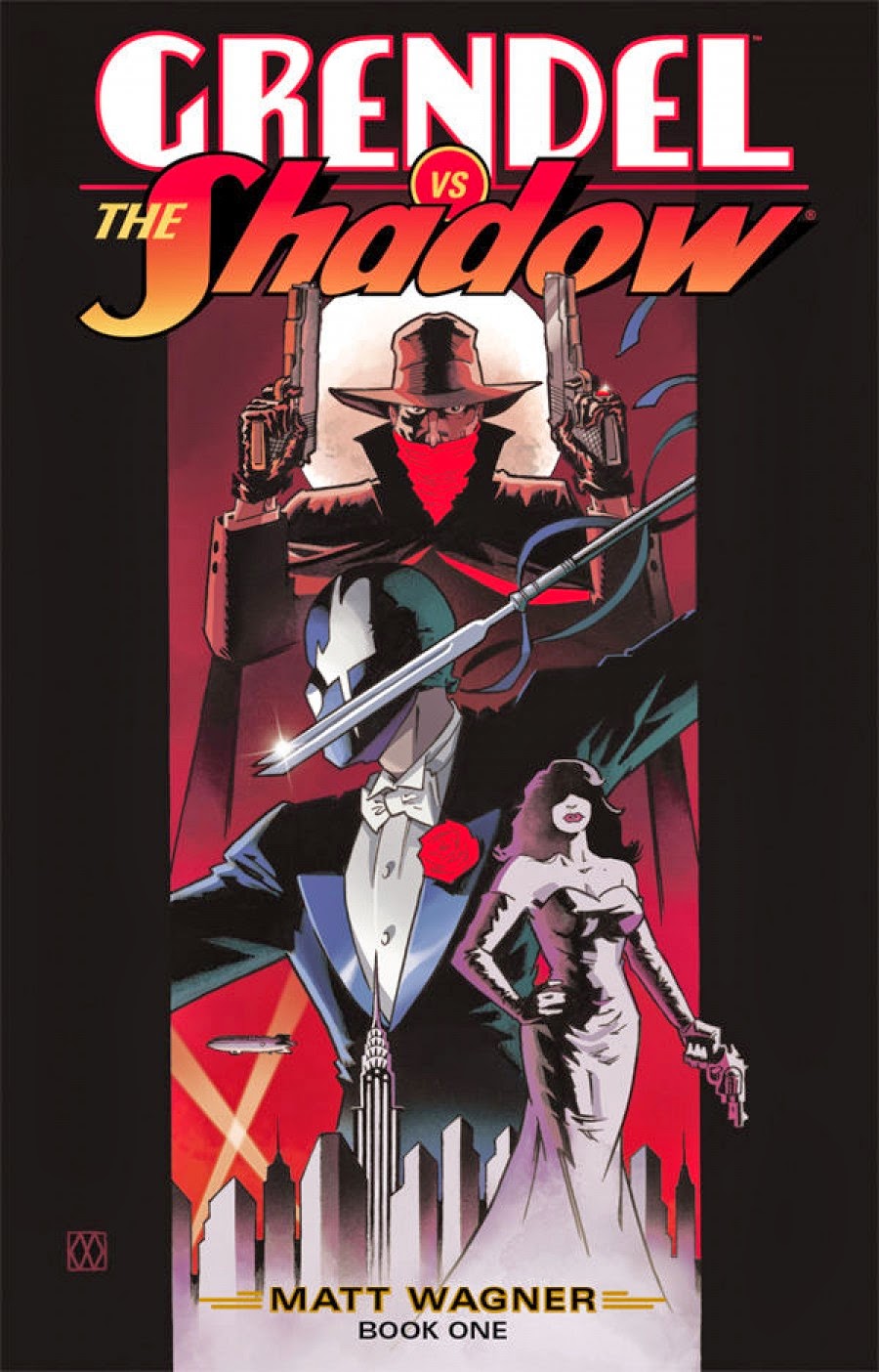
Comic book review: Grendel Vs. The Shadow- Book One- Starring Grendel, the biggest douchebag in comic book history


Writer & Artist: Matt Wagner
Colourist: Brennan Wagner
Publisher: Darkhorse Comics/Dynamite Entertainment
Released: 3rd September 2014

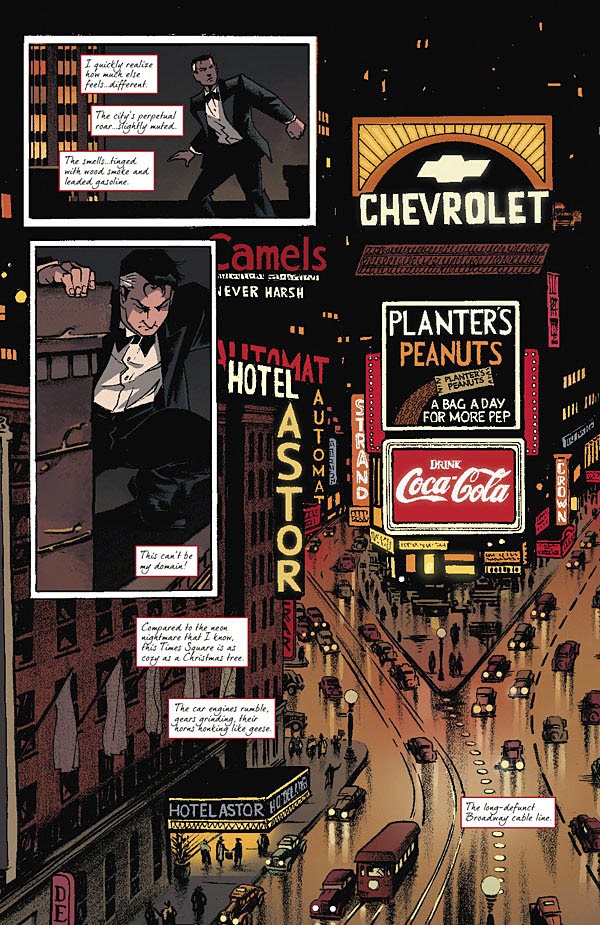
I was a little confused with one of the lines in the opening segment of this book. A sociopathic asshole called ‘Grendel’ appeared to go through some kind of time travel device and whilst surveying a New York city skyline (I knew it was new York because it featured the unmistakable image of the Empire State building) asked, Where are the twin towers?’

My initial reaction was very favourable. Brilliant, I thought. I’m finally going to get a Shadow story set in a post 9/11 world. I’m finally going to see the Shadow deal with contemporary concerns like NSA surveillance, criminal wall-street banksters owning everything and everybody, illegal foreign wars based on lies, the deliberate collectivisation of a dumbed down, television watching slave population and all of the other nightmarish realities that are rapidly destroying America in 2014. But no, after reading on I quickly realised that the reference to the missing twin towers didn’t mean that he was in the present, no he was in the past, before they were built. In the 1930’s, and that’s unfortunately where the Shadow still was.

The obvious question then is, what era is this Grendel piece of crap coming from? After a quick Start Page search (I refuse to use the NSA search engine of choice Google) I learnt that this Grendel moron (I immediately took a vicious dislike to him) is a 1980’s creation by Matt Wagner. So rather than bringing him into the present day (which would make him far more relevant and interesting) I guess he’s still stuck somewhere in the 1980’s. That’s a choice of convenience. It’s the easy choice. You have your character staying in the safe 1980’s and you don’t have to talk about any of the issues that are effecting the world today. I hate it when my comic books do that. I find it cowardly, very cowardly.

Having got all of that off my chest I want to quickly state that I didn’t hate this book. It was enjoyable, and as long as you don’t think about things too much it’s a good little comic. I’ll tell you what I’ll do. I’ll list the pluses and minuses of the book, and see whether or not I can recommend it. First off, the pluses:

The colouring in the book is vivid, dramatic and very effective. It creates an atmosphere all of it’s own, and together with the BADDA BADDA BADDA textual sound effects (that was a gun) it’s almost like a cheesy episode of Batman from the 1970’s. It’s silly, very silly, with very bad villains and very good heroes. The plot is childishly simple to follow and the Shadow himself keeps popping up in the err, well Shadows with his trademark HAHAHAHAHA laugh. It’s a lot of fun, it’s just well, it’s a lot….silly.

The minuses of the book are very apparent. The female characters are either angels or sultry, seductive vixens. They are add-ons to the male characters, and that really does stand out in 2014 where female characters are portrayed as the protagonists. A lot of modern readers will hate that. I don’t hate it; I just find it a little strange, a little old-fashioned and a little bit insulting, even though I myself get fed up of contemporary comics where the females are always in charge.

The character of Grendel, as you’ve probably already noticed from my brief descriptions of him, is extremely unlikeable. The guy is pretty much the living dictionary definition of a complete and utter twat. A drug dealing kingpin who doesn’t value human life, at all. In this book he’s portrayed as a super dashing, ultra-cool, handsome, debonair, erudite Nietsche ubermensch. In other words, uggggghhhh, he’s repulsive and I want to see the Shadow hand his ass to him for two books straight. I can’t believe that this twat was a major character for so long in the 80’s and 90’s. What the Hell were people thinking, buying books about this repellent douchebag?

This assbag Grendel character comes across as a wish-fulfilment fantasy character for writer Matt Wagner. In this single issue Grendel uses his awesome acrobatic ability and the super technology of a knife on a stick to bring an entire Mafia family to it’s knees. Oh, and he’s also a brilliant author as well, somehow knocking out a society adored best seller in about ten minutes flat, and he’s extremely handsome and all of the hot girls want to sleep with him, obviously. Oh God, this is verging on the laughable. It’s like a bratty, twatty fourteen-year-old has written himself into a comic book. Aggghhh, unbearable.

So why did I largely enjoy this book? It wasn’t just the colouring, was it? Strangely enough, I think it largely was about the colouring, and the knowledge that the Shadow is lurking in the backgrounds just waiting to kick lumps of crap out of the bag of shite douchefarm known as Grendel. You know what? I’m going to get the next two issues of this book. Matt Wagner has made me hate his Grendel character so much that I want to hang around to see him get kicked out of the 1930’s and sent back into the safe, nowhere land of the mid 1980’s, hopefully to never return and darken the Shadow’s path ever again.

I would have been absolutely thrilled to read a book with the Shadow in a post 9/11 world, but I didn’t get it here. Hopefully somebody out there in comic book land is reading this rant/review and they can do that? Go on, be brave. DO IT. But for the time being I’ll take what Shadow action I can get. His red scarf looks really cool in this book, and I’ll keep on reading just to see him hand Mr 1980’s Grendel his ass in a handbag.

Rating: 7/10 

Thursday, 21 August 2014

Comic book review: Justice Inc #1- The fascinating re-birth of The Avenger


Writer: Michael Uslan
Artist: Giovanni Timpano
Publisher: Dynamite Comics
Released: 20th August 2014

I had to re-read a couple of the pages in this book, going back over them a few times to fully understand what was going on, but it was a rewarding experience as the book was so enjoyable. What made it so enjoyable? Three things, the characters, the contemporary references and the fast moving tension filled script.

First off, the characters were fascinating to me. They are old pulp fiction comic book heroes from the 1930’s and 40’s, but there’s a wonderfully contemporary feel about them in this book. Writer Michael Uslan has been very clever here, using contemporary news stories to link the old heroes to the current times. I won’t spoil the plot, but it involves the Large Hadron Collider, a missing passenger plane and worm holes in time. These contemporary themes are mixed with old science fiction (H.G Wells) and Albert Einstein’s theories on the laws of physics and string theory. Add to the mix a very modern distrust of the government and a villain determined to use the powers of the occult to bring in a new age of mysticism and you have something that’s a little confusing, a little too packed, but something very interesting indeed.

I’m not going to get too carried away with the book at this stage as the art is not going to wow anybody, and the ending doesn’t really pack the punch that it should do, but there’s so much happening, and it’s such a joy to read. The research carried out for the production of this book must have been immense and the characters are so intriguing that I cannot help but be impressed by it all. There’s a lightness and air of fun about the script as well. It’s not lead weight and overly serious, it’s fun to read and the dialogue has moments of humour throughout (“It’s a dinosaur. A dinosaur I tell you.”).

After reading this comic book I went onto the Internet and did a bit of research about the character called ‘The Avenger.’ He sounds like a very interesting guy to me, so I’m absolutely thrilled that he’s back in contemporary comics, and I have my fingers crossed that he’ll be a huge fan favourite and stay around for a long, long time. I knew nothing about him before reading this book, but because of the way that writer Michael Uslan has re-introduced him, he’s become somebody that I’m very excited about. Please check out the link at the end of this review, and then read Justice Inc #1, and I’m sure you’ll agree with me on this point. I bought this book for The Shadow, but it’s the Avenger character that is going to keep me coming back.

I highly recommend this book, and even though the ending isn’t quite as strong as it should be, that’s not a big concern, as what has been established here is a template for what is to come next. It both fascinates and impresses me to see these old pulp heroes very cleverly brought into 2014, yet not seem dated at all. This is how to re-introduce old comic book characters and make them seem relevant to the world of 2014. I just hope that modern readers will take a chance with them. Justice Inc #1 is a clever book, an intriguing book and a book that’s just a heck of a lot of fun to read.

Rating: 8/10


For further information about 'The Avenger.' Please have a read of this fascinating info from our ever reliable friends at wikipedia-
https://en.wikipedia.org/wiki/The_Avenger_(character)

Friday, 1 August 2014

Comic book review: Sherlock Holmes- Moriarty Lives #5- Occupy Moriarty?


Writer: David Liss
Artist: Carlos Furuzono
Cover artist: Francesco Francavilla
Publisher: Dynamite Comics
Released: 30th July 2014


This concluding issue of the re-emergence of Professor Moriarty, after his near death at the Reichenbach falls, offers one slightly confusing misdirection, before wrapping things up in a slightly disappointing, and pedestrian manner.

There's our hero, with a nice little hipster goatee
That’s not always a bad thing of course. Endings that twist and shock but make no sense are far worse than endings that fail to surprise. And anyway, the entire purpose of this book was to explore the character of Professor Moriarty, his philosophy, his morality and his methodology as well. It achieves those goals and along the way there was some fantastic dialogue coming from the mouth of the Professor himself.

Unlike a lot of real world (top-level) criminals that operate through the secret occulted family blood-lines that control modern day finance, corporations and government, Professor Moriarty appears to be a self-made villain. He might have inherited his evil in a genetic sense, but he didn’t need to be born with a silver spoon in his mouth to get where he is today. Everything he achieved in this book was without outside assistance. Surely if the man operated a global criminal empire of such power and influence he would be able to get word out, and get some help in the little town he found himself washed up and alone in?

No help came his way, and he didn’t ask for any either. Is he doing this to prove himself? Or is his criminal empire not as powerful as we might think? You’d think that the main spider in the web of criminal evil would be more powerful, wouldn’t you? You don’t see that here. What you see is a self-made man, the ultimate capitalist.

You can criticise the underlying ideological and socio-political assumptions made here. You can even call it out for naivety. Writer David Liss has bought into the idea that the world is full of self- made men, battling for control on a level playing field. I would strongly disagree, and argue that this is not the case. The world is ran by a tiny minority of rich families and populated by billions of poor families. It is a slave colony. The rich families get richer, and the poor families get poorer. And the middle families, they get sucked further down, not further up. Sure, there are exceptions to this rule, but exceptions just prove the rule itself.

The villain is a big fan of Guantanamo Bay
Occupy Wallstreet talked about the 1%. That 1% is not one man. It is a group of families that own everything and everybody. If Professor Moriarty really was the spider at the centre of a global web of crime, as described by Sherlock Holmes, he would be a part of the 1%, not just another 99 percenter, as he appears to be in this book.

Our crony capitalist playing field is not level, and these days it’s hard to argue that it is. It is a field where you can battle against the bloodline elite’s, or you can join their anti-human, satanic control system. Most chose to join it, some consciously, most unconsciously. From politicians, to bankers, to corporate leaders, to drug cartel kingpins, to child traffickers, to child ‘educators,’ to television ‘programmers,’ the evil that exists in this world today is organised evil, not a self-made lone evil as represented by an individual like Professor Moriarty.

That was kind of the point in Conan Doyle’s original stories, at least as I read it. Moriarty was rarely seen, and when he did appear he was an abstract figure who only communicated with Holmes, not Doctor Watson, the writer of the stories. Did Moriarty even exist? I would argue that no, he didn’t exist at all. The ‘Moriarty’ system operates through its agents, and one of those agents battled Holmes at the Reichenbach falls, but the system is not one man.  Moriarty represented a hidden power, rather than a hidden individual. It was not about him, it was about something deeper, more occulted than that.

The slaves are starting to question their masters
It’s a mainstream idea that the world is fair, and that the strong can rise to the top. All of the research and reading that I’ve ever done indicates that this is not the case. There is scope for change at the lower levels, and you can advance your position, but the top is fixed. You can join it of course, but you will be a servant, not a master. Just another slave to the control system, no matter how big your house is, no matter how pretty your wife is, and no matter how much money you have in your bank account.

‘Moriarty’ is not a man. He is the criminal system itself. The one percent that the Occupy movement have been trying to tell the world about.

Narratively speaking, this concluding issue of Moriarty Lives wraps things up in a fairly formulaic manner. The bad guy is defeated; there is some misdirection (that confused me, so it didn’t work), and a promise that perhaps we’ll see more of the Moriarty character in future Sherlock Holmes books.

I enjoyed the dialogue more than anything else in this run. It was very good, insightful even. The underpinning societal assumptions were problematic to me however. The art was average, at best, and the narrative ends on a slight down, rather than the up you would need to get readers really enthusiastic and demanding more from the Moriarty character. It was still a good read though. I enjoyed the interpersonal dynamics between Moriarty and his young apprentice, there are some valuable life-lessons in the earlier issues as well, and the cover artwork by Francesco Francavilla has been gloriously gothic, atmospheric and consistently excellent throughout the entire five-issue run.

Rating: 7/10


Thursday, 17 July 2014

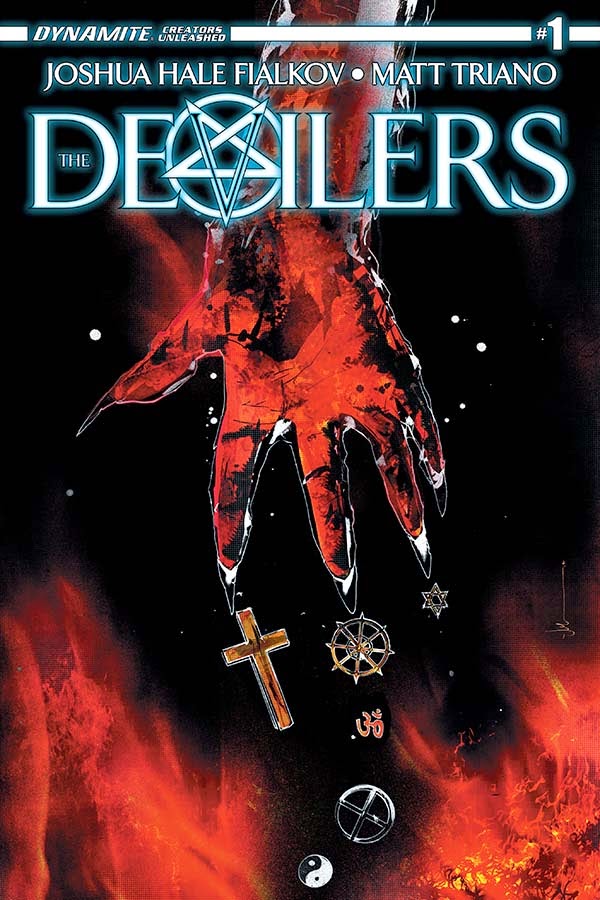
Comic book Blitz review: The Devilers #1- A bit tame, but understandably so


Writer: Joshua Hale Fialkov
Artist: Matt Triano
Colourist: Mark Roberts
Publisher: Dynamite Comics
Released: 16th July 2014


This is a book that has to walk a tight-rope because it’s dealing with a number of world faiths that have huge problems with each other, these problems frequently resulting in bloodshed. The basic premise of the book is that demons are being unleashed upon the world, and that all the faiths have special warriors that are putting their differences aside, getting together as a team to defeat the demons. Issue #1 does a decent job of not offending anybody, but I always say that if you’re not offending anyone, you’re probably not saying anything.

The book isn’t going to say anything then, although it does have a bit of a pop at atheists, and that’s nice because it doesn’t normally happen, but it’s not exactly a dangerous thing to do is it?

The book then has to be judged on whether or not the story is exciting and whether or not you care about the protagonists. I didn’t really care, as they were just the usual collection of cynical people and cute feminist empowered comic book girls who will punch you in the face. The story isn’t that exciting to me either, as it’s just another team of heroes fighting against some bad guys. The art was a bit average, but I did enjoy the dark colouring. That worked well. I won’t be following this book because by its very nature it has to be a bit safe. It’s not terrible though, and I do appreciate the way that the writer is getting the Abrahamic faiths to work together against evil forces, it’s just a shame that it doesn’t happen here in the real world.
Rating: 6/10