“Never, ever underestimate the degree to which people will scatter themselves into a deep fog in order to avoid seeing the basic realities of their own cages. The strongest lock on the prison is always avoidance, not force.” (Stefan Molyneux)
Showing posts with label Russia. Show all posts
Wednesday, 25 November 2015
Government Girl vs. The Truther (A webcomic about the deliberate suppression of truth)
Labels:
comics,
Free Comics,
Gitmo,
Gitmo Girl,
Government Girl vs The Truther,
ISIS,
nato,
NCBD,
new world order,
Politics,
Russia,
Satire,
Statism,
turkey,
Webcomic
Thursday, 3 September 2015
Comic review: Midnighter #4- Starring (or not) Cecil, the Vampire Lion
Writer: Steve Orlando
Artist: Stephen Mooney
Publisher: DC Comics
Released: 2nd September 2015
If you’ve read any of my previous reviews you’ll know that I’m a bit of a reality junkie. I like my comic books to be controversial, to be edgy, and to say something about the world as it is today.
![]() |
| 'Yo man, where's that vampire lion at?' |
Their writers are not brave, or edgy, or controversial. They might be talented, but truth-tellers they are most certainly not. They write what they are allowed to write, and the best and most celebrated comic book writers of our times push mainstream programming narratives without even realising it.
I’ve taken it upon myself to buy these books, these neoliberal vehicles of New World Order consensus, and to talk about the programming they are feeding into the minds of their readers. This doesn’t make me very popular, but that’s okay.
If you want to read a review that talks about how good the stories and art are, go somewhere else. My reviews are not about how ‘cool’ the characters are, or how ‘cool’ the art is, or how ‘cool’ the plot twists are, or how ‘cool’ the references to previous books are. I talk about the socio-political assumptions that the books are making. That’s what I do, and that is the only reason why I review daft comic books like Midnighter #4.
I haven’t read the book before, and I’m not familiar with the characters. Before purchasing the book all I knew was that the story involved Russia, and that it has vampires in it.
The book begins with a sub-heading- Moscow, the Forty-Forties.’ That’s already confusing. Does it mean the real world 1940’s or some comic book time period that never existed? By the end of the book I was still unsure about that. Anyway, the plot is a comic book critique of those rich people that go on Big Game hunting safaris. In the real world there was controversy over some dentist bloke shooting a lion called Cecil. He thought that he was allowed to shoot it, so he did. However, he wasn’t actually allowed to shoot poor old Cecil, the tour guide had deceived him, and now he’s a figure of worldwide hate. Humans are very odd. Shoot a lion and they get very upset, kill a million cows, and the same people couldn’t give a s***. Oh well, that’s the madness of our times.
Midnighter #4 replaces animals with vampires, with the rich people paying to kill a vampire, as opposed to a big cat. The book shows a group of men partying, killing a chained up vampire and feeling all macho about themselves for doing so. The heroes in this tale are two pretty boys who are going to give those evil vampire killers what they deserve. One is the Midnighter, and the other is Grayson. I couldn’t tell them apart, as they look the same, have the same physiques, and both engage in the same quips and smart-ass action hero banter.
![]() |
| Here come the tough guy heroes. |
Do they work for the UN? Probably, because as we all know, the United Nations are the good guys, cough Rockefeller funded Zionism. Err, aren’t they? Of course they are. Don’t question the programming, enjoy the book, wow, it was so cool, did you see that punch and quip, and oh yeah, hunting is bad, eating meat is okay.
The book concludes, as all good comic books conclude, with a seeming defeat for the villains, and with the evil mastermind behind it all laughing and declaring that his plan is going just as he envisioned, and that the heroes don’t know what’s in store for them next, ha ha ha ha ha.
So yep, Midnighter #4 is just another comic book. The brave and daring libtard message is that hunting is bad, and that you shouldn’t kill defenceless animals. It’s a comic book that you can safely enjoy at McDonald’s with a Big McCancer burger whilst feeling good about yourself. If the two heroes were either vegetarian or animal welfare workers then it would have helped to clarify the meaning in the book, and it would also have given it all a sense of moral legitimacy, but there was no mention of vegetarianism or animal welfare anywhere within the narrative. Hey man, the message is confused, of course it is, that’s DC for you. They are parroting the popular lies of our times, and as lies are always contradictory, that’s what you get in books such as this.
Rating: 4/10 (Stupid quips and punches comic book that replaces Cecil the Lion with pretend vampires, oops was that a spoiler?)
Labels:
Big Game Hunting,
Cecil the Lion,
comic review,
comics,
DC comics,
Grayson,
Midnighter #4,
Russia,
Vampires
Monday, 27 July 2015
Comic review: C.O.W.L #11- The Final Issue
Writers: Kyle Higgins & Alec Siegel
Art: Rod Reis
Publisher: Image Comics
Released: July 2015
I’ve read the entire run of C.O.W.L, and now it’s over.
So, was it worth it?
Just about.
I had problems with it. I still don’t understand why it was set in a make-believe version of the 1960’s. I don’t understand why you would do that when the world of NOW is so fascinating and there’s so much that you could say about it in a truly controversial comic book narrative.
The creators of C.O.W.L have already announced their next project. It’s an alternative history book, set in a future where the cold war tensions of 1985 led to nuclear detonations in Moscow and New York City.
Again, why do you need to go back? Is there not tension between Putin’s Russia and the neo-liberal, corporate US imperialist war machine of today?
Why not use that as a fictional launching pad as opposed to cold war tensions of over thirty years ago?
What are they scared of?
It bewilders me, but then again, perhaps not. Do US comic book writers really want to shine a spotlight on their country, and look at what they have actually done to the world in the past decade alone?
Looking at contemporary US comic books, it appears that they would rather not look.
I read comic books and I see safety, identity politics, personalities not issues, and a refusal to address the neo-liberal corporate consensus of our times. That’s what I see, and it depresses me that writers are either not smart enough, or not brave enough to tackle the important issues in our world today.
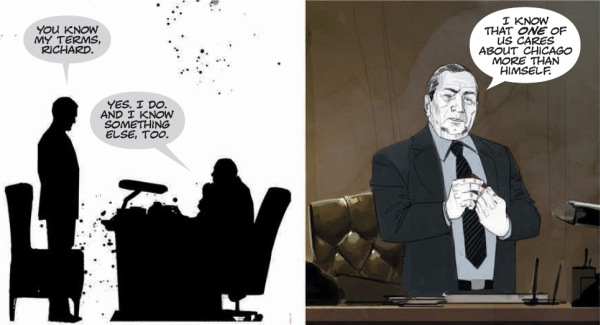
C.O.W.L #11 concludes with a whimper. The guy in charge of protecting the people from villains is the biggest villain of them all, and is probably funding, manufacturing or controlling all of the threats in order to justify and maintain his position.
Of course he is, that’s how it works. See the F.B.I and their counter ‘terrorism’ 'work' in the US for the past decade alone for more details.
That one idea, that those in charge of stopping threats have to manufacture them, is not enough to sustain an entire comic book series. It’s not really enough to sustain a one shot either, as it’s a twist that isn’t really a twist at all. For anybody paying attention to how the world actually works, it’s a given.
Perhaps I’m making assumptions here? Perhaps other readers think that the law exists to protect them? Perhaps other readers still think that cops are heroes and that politicians represent their voters? I don’t know about that. I like to credit people and assume intelligence rather than assume the worst.
Having said all of that, the main problem I had with C.O.W.L was not the obviousness of the plot. It was the needlessly complex structure of the narrative itself. This was a difficult comic book to read. It wasn’t just ‘involving’ it was a bloody maze with prickly thorns on every corner. I like reader friendly books, and I could never describe C.O.W.L as reader friendly.
There were too many people, too many plot threads, and too much going on. It was far too crowded and that took the fun out of it all. It should have been a simple comic, but it became too convoluted, too pofaced, not enough fun, and far too serious for it’s own good.
C.O.W.L probably thought that it was a bit cleverer and more important than it actually was. I hoped that it would be about something more than personality conflicts and office politics, but in the end, it really wasn’t. It was a book with a coathanger of a theme, but what it was really about was the individual characters and personalities involved.
A lot of comic book (and other fiction) readers, love to read about characters and personalities and how they manipulate each other in a big old gross Game of Thrones kind of way. They love that human intrigue stuff. They love the sex and violence, and betrayals and scandals and outrages. I personally couldn’t care less. I’m interested in issues, not personalities. People bore me, they always have done. I know you aren’t supposed to say that, but sod it, it’s true. I’ve always found people to be tiresomely predictable. They pretend to care, but only really care about themselves. I don’t want to read about people. I want to read about something more interesting than that.
I was the only person in my comic book shop that was reading this book. I had it on sub. Nobody else was interested. I thought that it was okay. It was not a bad book. It had one thing going for it, that idea that those in positions of government sponsored authority sometimes have to manufacture enemies in order to justify their budgets and positions. Apart from that though, it won’t linger long in the memory.
C.O.W.L (Chicago Organised Workers League) was a comic book about the 1960’s, a fake 1960’s. It had superheroes and unions in it. It had lots of characters, too many characters. They were all screwing each other over. It was very serious. Readers were turned off because it looked like a boring book about union issues and politics from fifty years ago. I think that it was trying to get an award, or something. Okay then, that’s a comic book.
Rating: 6/10 (C.O.W.L is no more. It lasted too long, was okay for a while, but I’m happy that it’s over)
Labels:
C.O.W.L #11,
comic review. Image comics,
manufacturing terror,
Putin,
Russia,
US Imperialism
Friday, 1 May 2015
Self-Censorship in Contemporary Comic Books- Review: Sherlock Holmes VS. Harry Houdini #5
Writers: Anthony Del Col & Conor McCreery
Artist: Carlos Furuzono
Main Cover Artist: Aaron Campbell
Variant Cover Artist: Colton Worley
Publisher: Dynamite Comics
Released: 22nd April 2015
*NOTE: THIS REVIEW FEATURES MY LIST OF NEO-LIBERAL POLITICALLY EXPEDIENT COMIC BOOK HEROES AND VILLAINS
By far and away the best aspect about this entire Holmes Vs Houdini series has been the awesome front covers. The plot of the book itself stopped interesting me a while back, and in this final issue it has devolved into some daft, but at least highly contemporary anti-Russian fear propaganda.
![]() |
| Variant cover by Colton Worley |
What do I mean by ‘convenient’ villain? I mean that if you use a Russian villain in your book nobody is going to get upset about it. Heck, nobody will even mention it, well except for blokes like me on my blog.
I won’t go on too much about contemporary geo-political events, but Russia is starting to be demonised and given their cold war era ‘enemy of freedom’ status in the mainstream media once again in 2015. What is portrayed in the corporate mainstream media (as they are the great arbitrators of reality, right?) often trickles down into other forms of popular media as well, such as WWE wrestling, and comic books. So if the evil Russians are the villains on the (fake) news, why not use them as the fake bad guys in comic books as well?
If Russia is the convenient or expedient villain in 2015 who are the people/countries that comic book writers will not use as villains? Interesting question, don’t you think? People might not like to hear this, but in the western world at the moment we are living in the times of neo-liberal political correctness. You can criticise some people, but if you criticise others then it’s CAREER OVER.
Here are the main groupings (in my opinion, and based on my reading of hundreds of comic books over the past decade) of people who you are NOT allowed to criticise.
Non whites. (If there is a tint in their skin, don’t go there)
Homosexuals.
Immigrants (Any criticism of mass immigration will lead to accusations of racism).
Muslims.
Jews.
Feminists.
Social justice warrior campaigners.
The armed forces.
The Police.
China.
Saudi Arabia (and all of the other Gulf dictatorships supported by the west).
Israel.
Democratically elected (selected, in reality) Governments.
I’ve missed a few, obviously, but I think that’s a pretty good starting list. If you are not allowed to criticise any of the above groups of people, who are the groups of people that you are allowed, or even encouraged to criticise in our politically correct neo-liberal times?
The following list is the neo-liberal politically correct go to people that you ARE allowed to use as villains in 2015 comic books. Again, this list is based on my own experiences of reading comic books over the past decade.
White men.
Gun owners.
Survivalists/Preppers.
Southern Americans (always portrayed as redneck racists).
Nazi’s.
North Koreans.
Dictators (Not those supported by the west obviously)
Russians.
Homophobes.
Racists.
Misogynists.
Christians.
Aliens.
Truthers (The 9/11 truth people and anybody who questions government/media lies).
There are rare exceptions, when individuals in one of the two groups are shown to be heroic or villainous, but when this happens that person is not held as a representative of the group as a whole. You’ll get a crooked cop, but there’s always a good cop to defeat him and make sure that the organisation as a whole is not denigrated. You’ll get a nice Christian, but most Christians are still presented as crazy cult followers, and if you are looking for an evil Muslim or a crazy feminist character (they do exist in reality you know) then contemporary neo-liberal comic books are not going to be for you.
So looking at my two little lists, put yourself in the role of a comic book writer. You need a villain, so who is it going to be? You can’t use real life villains such as Islamic terrorists, or murderous cops, so what do you do instead? Easy, you pick a Russian or a Nazi, or a racist white man, or a Christian cult leader, or an alien and you make the story about personalities and exciting plot twists. You avoid the real issues of our times, and steer clear of all of the controversies that will get you in trouble with the neo-liberal politically correct thought Police that will call you bigoted or racist if you dare to go up against them.
Sherlock Holmes VS. Harry Hoodini uses a Russian villain, good old faithful mad monk Rasputin, and creates a safe scenario where the US (represented by Houdini) and the UK (represented by Holmes) team up to beat the evil red threat. You can do that, you are allowed to do that, nobody will mind, and you’ll have comic book fans putting up reviews that talk about the art, the plot and how exciting it all was, or whether or not it all made sense, or surprised, or entertained them.
To me it was just another comic. It messed up a bit after the second issue, and played a bit loose with the detective formula, but from that point on it kind of cruised to the end. The villain lost, his motive was hate, nothing deeper than that, don’t think too much about it, as it’s not important. All you need to know is that it was a fun ride and the heroes won, end of story, or is it?
I didn’t hate the book, but it wasn’t really doing anything. It’s not going to linger long in my memory, but nobody was offended, the covers looked great, and I’m sure that Holmes and Houdini will return. The characters are cheap, available, easy and safe and they have name value that is guaranteed to gain you at least a little bit of interest. I don’t blame Dynamite Comics for using them. If I wanted to sell a few hundred comic books then I’d probably do the same thing myself.
I’ll finish off this review with a quick message to writers Anthony Del Col and Conor McCreery.
I wasn’t that impressed with the content of the book, but no hard feelings lads. I enjoyed the covers, and they are going to look great on my bedroom wall. Best of luck with all future projects, but go on, take a chance. Say something that you are not allowed to say. Be brave. It will be fun.
Rating: 6/10 (Lots of action and last second surprises and twists in this final issue, but the story didn’t say anything, other than to remind readers that it’s still politically expedient to have Russian villains in contemporary comic books)
Please let me know if you agree or disagree with my list. Did I miss any group out? Who do you think you are allowed to criticise, and who do you think that you are not allowed to criticise in contemporary comic books?
Labels:
comic review,
comics,
Dynamite comics,
neo-liberalism,
Russia,
self-censorship,
Sherlock Holmes vs. Harry Houdini
Wednesday, 3 September 2014
Comic book blitz review: Grayson- Future’s End #1- Uniformly rotten and bordering on the unreadable.
Writer: Tom King and Tim Seeley
Artist: Stephen Mooney
Publisher: DC Comics
Released: 3rd September 2014
There’s a very confusion structure to this book. The narrative is played out in reverse, with an ‘Earlier’ tag on just about every page telling the reader that the story is going back in time, not forward. To me this device does not work because it is both confusing and irritating. Half way through the book I was getting very frustrated, and very lost. I had to re-read the book from back to front to try and make any sense out of it.
The book's confusing narrative begins ‘Five years from now’ in a world where the evil Russian Federation has taken over Eurasia. That’s a contemporary concern, so it’s nice to see it played out in a DC comic for a change. It pretty much plays into the ridiculous mainstream media narrative though with Russia portrayed as the expansionist, war mongering villains and the good guy, heroic super agents representing America doing all they can to save the poor, helpless civilians. Sounds familiar doesn’t it?
Reading this book was like watching the bloody awful mainstream news and that is not a good thing at all. Writer Tom King shows a worrying inability to think outside of the very small box that is given to the average drugged up and dumbed-down television viewer.
The art in this book was uniformly poor, with lazy backgrounds, poorly pencilled facials and weird spatial renderings. I expect much better quality in my comic books than what I got here.
Grayson #1 has a confusing structure and very poor art. The plot is very silly with attractive young special agents fighting against evil mainstream news Russians. It had a great front cover though. I love the 3D effect, it’s just a pity that what’s inside the actual comic is uniformly rotten and bordering on the unreadable.
Rating: 2/10
Labels:
Batman,
Comic book review,
DC comics,
Eurasia,
Future's End,
Grayson #1,
review,
Russia
Subscribe to:
Posts (Atom)