“Never, ever underestimate the degree to which people will scatter themselves into a deep fog in order to avoid seeing the basic realities of their own cages. The strongest lock on the prison is always avoidance, not force.” (Stefan Molyneux)
Showing posts with label Socio-political. Show all posts
Thursday, 28 May 2015
Comic Review: Material #1- Slaves to the Wage
Writer: Ales Kot
Artist: Will Tempest
Contributing Author: Fiona Duncan
Publisher: Image Comics
Released: 27th May 2015
There’s a long essay at the end of this book, and it goes on and on and on. Self-obsession, sex references, Marxism and a bit of moaning about neo-liberal capitalism are the themes, but does it really say anything?
I was going to do a short review on this comic book, keeping it simple, unlike that long essay, but as I was writing this review I answered my own question about whether or not that essay actually said anything, and I changed my mind about a couple of things.
Don’t be confused, this won’t be complex. I’m a simpleton, so don’t worry about not being able to understand what I’m going to go on about here. What I have to say about the essay ties in with the themes of this book, so I’ll discuss those themes first.
Material #1 is about unsatisfied, depressed, confused, traumatised, disaffected people.
There’s a Chomsky like professor who is sad, as I expect the real Chomsky to be as well. After all, being a careerist gatekeeper to real truth can’t be that much fun, can it? This professor talks his theories, but is in the process of questioning reality itself.
There’s a girl, an actress, she takes drugs, is creative, and self obsessed. A director wants to make a movie about her. Why? What’s going on here? We’ll find out at as the book progresses.
Next we get some ‘I can’t breathe’ panels of horribleness, with some order followers doing what order followers always do, and a young boy possibly being radicalised by the control system that shouldn’t be as he witnesses scenes of order follower (cop) violence.
Next there is some sex stuff that involves a bloke released from Gitmo. He’s innocent, messed up, and it’s sex stuff. He’s sad and confused, as you would expect him to be, but the sex stuff felt a bit over the top, a bit too outrageous, just for the sake of being outrageous, but that’s opinion. I’m not a fan of the weird sex stuff in ‘adult’ comics. Bottom line, I don’t think that it’s necessary.
Then we get some real world horribleness again, with some panels showing a young boy being interrogated in that Chicago black site called ‘Homan Square.’ Hey, it’s order followers just doing what they do. You vote for a master, you get a goon in a black uniform that’s how it works. That’s democracy, suckers.
Then Chomsky (his name is Julius Shore in this book) gets an email. The email claims to be from the, ‘First artificial human intelligence on earth,’ and finally, amidst the sex stuff and sadness we have some semblance of plot. There’s no connection between the characters as of yet, but at least something interesting appears to be happening.
The book then goes to the self obsessed girl and her movie, hints more about the radicalisation of the young boy, and concludes with the sad Gitmo bloke wanting to have a chat with the girl he pays for sex. It’s a weird ending, but then again, I guess it was supposed to be.
So, what do I make of it all? Look at the subject matter: Gitmo, Police brutality, the radicalisation of youth, useless academic careerism, human life being defined by ‘Market Value,’ and the vague notion that things have to change, if not, we might as well not bother getting out of bed in the morning.
That’s my kind of stuff, the kind of stuff that I talk about on my blog, and in real life, and the kind of stuff that results in one overwhelming reaction.
That reaction being, indifference.
I’m a reality junkie, writing about a genre (comic books) that has an audience of hard working people, busy people (it’s a theme in this book) that have no time for my reality/truth nonsense, and would rather spend their free time reading about superheroes, and cool stuff that reminds them of when they were happy, when they were children.
I can understand that. I can understand the need to escape for ten minutes from a life that sucks. People that know me in the real world, the people that I meet at work and out and about, they don’t really like me. I know. It’s no secret. I’m not a popular guy.
People see me as somebody with too much time on his hands. They see me as somebody who does too much thinking, and not enough working. They dislike me because I jumped off the career, jumped off relationships, jumped off of the endlessly moving airport treadmill (goes back and forwards, but never up) way of living my life. They would like me more if I was more like them, if I stopped writing, stopped thinking, and instead spent all of my day working in a job, any job, just as long as I don’t have this wicked ‘too much time’ on my hands.
That is a mindset, and it’s nicely summed up by writer Fiona Duncan in her essay at the conclusion of this book. (Fooled you. I didn’t hate it. I just thought that it was too long). Here we go:
‘Everything has to be sacrificed to an abstract growth of money, and of value, of nothing. This is madness. This philosophy of the deregulated (neo-liberal) economy where everybody is demanded to give CEASELESSLY in order to survive.’
She borrows quotations from a Marxist (Boo) academic called Francis ‘Bifo’ Berardi, to make her point, but even though I have no time whatsoever for dusty old discredited Marxists, I have to recognise a point well made.
The problem that we have (as a whole) is a mindset problem. We have been taught through our schooling and mainstream media programming (funded by the neoliberal, free-market rulers of our time) that our value as people lies not in our actual inherent qualities as decent, moral human beings, but in our ability to maximise our own profit potentials.
This has turned money into a god, and humanity into a slave to that false god. I talk about the New World Order, and people hate me for it. I talk about governmental control systems (like Marxism) and people hate me for it. They want me to shut up, get a proper career job and to stop talking, please stop talking, just stop talking. They want me to join them, and I understand. The system, the society that has been created around them is all about joining, about maximising your earning potential, and when somebody like myself refuses to play the game, it makes them question the game that they are spending their entire life engaging with.
So what did I think of the book?
I thought that it had ideas that somebody like myself could interact with. It is a very different book, because it’s slow, and it has real world issues in it. I didn’t like the sex stuff, but sex sells, so I understand. Hang on. A book with themes that concern the maximising of earning potential includes a weird sex angle that reads very much itself like the maximising of earning potential. Is that ironic? What did Alanis say? Oh, she was wrong, yeah, funny.
Anyway, it’s not the sex that interests me about this book, it’s the ideas, or the possibility at least of ideas being discussed at all. The essay at the close of the book was a very good idea. It created more scope for thought, for ideas, for somebody like myself to interact with.
Here’s the problem, and I’ve hinted about it during this review.
Material #1 is a book that somebody like me is bound to enjoy and give a positive rating to, but do you know how many people I’ve met in my life who are like me?
Just one, and yeah, obviously, it’s me.
The book is talking about ideas, about the real world, about how messed up it is, about how we need to stop sleep walking through life and start doing something other than making money. Comic books largely cater towards the sleeping sections of society, the workers, the careerists, and the young people that want to join the money making, anti-human system themselves.
I enjoyed the book, and I’ll keep on reading. It intrigued me, it helped me to think, but in a comic book world largely dominated by fanboys/girls who want to chill-out and not think at all, how many other people will be up for this one? I’m the one comic book reviewer who is guaranteed to like this book, but I really do worry about what the other reviews are going to say about it. *
Rating: 9/10 (A rare book, worth checking out)
* Just checked the other reviews. There’s not many. The majority of the reviews gave the book a low rating and didn’t appear to understand it. It’s not surprising, as the mindset that the book is addressing is the same mindset of the comic book reviewers themselves.
Labels:
Ales Kot,
capitalism,
careerism,
comic review. I Can't Breath,
comics,
Fiona Duncan,
Gitmo,
Homan Square,
Image Comics,
Marxism,
Material #1,
neo-liberalism,
noam chomsky,
Socio-political,
Will Tempest
Friday, 16 January 2015
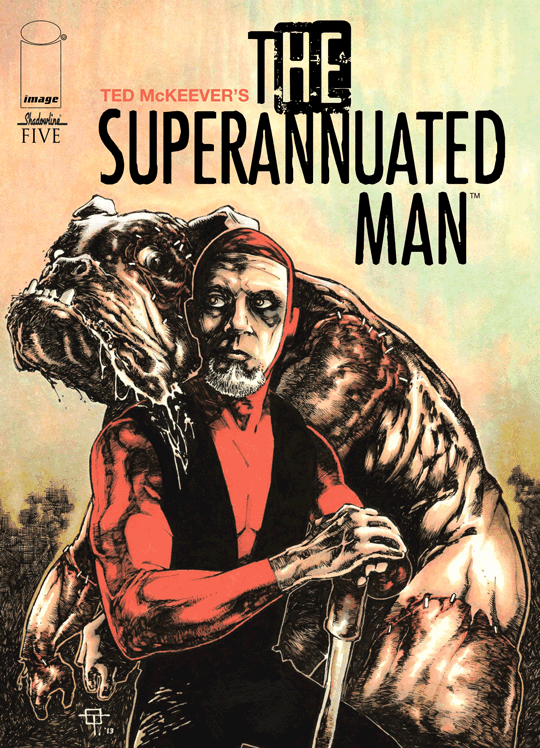
Comic review: The Superannuated Man #5- A warning from the future
Created, written and illustrated by Ted McKeever
Publisher: Image Comics
Released: 14th January 2015
A man making his living working off of ‘Blackwater’ Pier sees horrible animal mutations. A disease is coming, spreading rapidly, and he attempts to warn people. The people don’t want to hear him. He is told that, ‘No one gives a s**t,’ and is forcibly removed from institutions that could help. His warnings ignored, he resigns himself to a life of solitude where he witnesses the collapse of human civilisation.
What could this comic book possibly be saying?
Blackwater Security Company (they change their name frequently to confuse people, but this is the name they started with) are a private security firm that works in Iraq, and other countries that have been invaded/liberated/destroyed by western governments.
Blackwater (their current name is ‘Acadami’ but it will change again) has a simple job. They protect western interests as countries are looted on the pre-text of neo-liberal human rights and democracy. Here’s how the Guardian newspaper describes its operations:
‘The mercenary firm Blackwater has become a symbol of the utter lawlessness and criminality that permeates the privatised wing of the US war machine. The company's operatives have shot dead scores of Iraqi and Afghan civilians, while former employees allege in sworn statements that Blackwater's owner Erik Prince "views himself as a Christian crusader tasked with eliminating Muslims and the Islamic faith from the globe", and that Prince's companies "encouraged and rewarded the destruction of Iraqi life". (Jeremy Scahill)
A shrug of the collective shoulders, and a very clear, ‘No one gives a s**t.’ And what happens to a species when it no longer cares? What happens when morality disappears, when whistleblowers to state sanctioned evil are either imprisoned or ignored? What happens to a civilisation when it chooses to ignore morality, when it chooses to ignore reality itself?
Look around you.
Civilisation collapses. People act selfishly, and do what is best for them only, sod everybody else. The world burns and people warm themselves by the fire.
‘I suddenly found the sheer absurdity of it all to be completely and utterly…. hilarious.’ (Ted McKeever in ‘The Superannuated Man’ #5).
So what to do? Ted is laughing, and I don’t blame him. I’m going to keep on knocking out these reviews, keep on learning, keep on making mistakes, and keep on trying to improve myself as the world teeters on the edge of total collapse.
We haven’t gone over the cliff just yet. There’s still time to avert it, and the warnings are everywhere now. Will we heed them? Can we stop the end of everything? Yes, we can. But, as always, it’s up to us to do it. Nobody is coming to help us, it’s up to us, as it always is.
Rating: 10/10
Click link below for Guardian newspaper article quoted in this review:
http://www.theguardian.com/commentisfree/cifamerica/2009/nov/11/blackwater-mercenary-scandal-legal-sanction
Click link below for Wiki page on Blackwater/Academi:
https://en.wikipedia.org/wiki/Academi
Labels:
Blackwater,
Comic book review,
comics,
Image Comics,
Socio-political,
Ted McKeever,
The Superannuated Man,
The Superannuated Man #5
Wednesday, 30 July 2014
Comic book review: Evil Empire #3: The Hagman and Hagman Report of comic books
Writer: Max Bemis
Artist: Ransom Getty
Publisher: Boom Studios
Released: 30th July 2004
Just when I thought it was getting predictable, with the fake liberal left, and the fake intolerant right lined up as the heroes and villains of the book, something happens at the end of this issue that has thrown my expectations into chaos, thus making this third issue of Evil Empire more than just another formulaic politically correct leftist leading comic book, and something that is trying to get in touch with the pulse of our times.
![]() |
| Corporate enforcers enjoying their time off with drink and drugs |
I’m not going to spoil anything here, and I’m not going to detail the plot like many of those other boring and formulaic reviews you find on comic book web-sites. I'll briefly sketch some of the plot, but I'm going to spend most of this review talking about the bigger issues that the book is addressing.
This book is about the future of America, and how it has turned into a fascist totalitarian Police state ran by criminal elite’s and policed by drugged up psychopaths in corporate enforcer uniforms.
Yes, it’s the very near future, but like any good dystopic work of fiction, this is really talking about what is happening in America today.
So what is happening in the America of 2014?
America is a country where hard fought for freedoms are diminishing by the hour. A country taken over by private banks and corporations that own and control both mainstream political parties, and where democracy is a rigged game. A country where the media works against the people, lying to them, distracting them and telling them that black is white and up is down. A country where large numbers of people refuse to look at reality, simply because political correctness dictates that they cannot criticise a man of the president’s particular skin pigmentation. This is America as it is today, and yet the vast, vast majority of comic books just refuse to even go there, at all.
![]() |
| Here comes some justice |
Before I talk about the actual content of the book I have to give credit to artist Jay Shaw for the fantastic cover that adorns Evil Empire #3. It really is exceptional. It is a cover that says everything about the state of America as it is today. A flag dripping down the plug hole, leaving a bloody stain around the rim. That is America, slowly fading away in a pool of blood. Blood from it’s foreign policy of supporting terrorists abroad, and blood from it’s using the fear of terrorism back home to erect a concentration camp around the sleeping distracted masses.
And as America slips away the vast majority of it’s citizens obsess over sports, celebrities, materialism and divide and conquer media ploys like racism, sexism and homophobia. It’s a liberal thing in 2014. Guilt tripping over their own thought processes the President literally laughs in their faces as he deliberately flushes America down the plug hole of history.
The book begins with some drunken corporate enforcers getting what they deserve. It’s a very good start. It then jumps straight into a thrilling narrative about a right wing politician going all Satanic whilst the feminist liberal left (as represented by a pierced and tatooed rock star with a funky haircut) do all they can to stop him. If that was all that was happening here then I’d congratulate it on the cover, applaud it for the corporate enforcers being shown as the control freak psychopaths that they are, and then just leave it as another feminist liberal book that thinks that political correctness and socialism is going to save the day, and stop America from going down the sink.
![]() |
| Not everything is as it seems here |
This is not just an aware comic book though. It’s an exciting, fast paced and unpredictable comic book as well. The pacing is spot on, and there is barely a wasted panel in the entire book. This book is tight. It doesn’t mess around.
Evil Empire really intrigues me now. Last month’s issue did a great job of sending me off in the wrong direction, but after the exhilarating events of issue #3 I’m back on this bandwagon big time.
This one could be very good. It’s a book unlike so many others, in that it appears to at least be attempting to interact with the reality of the world as it is today. How revolutionary eh? A book that hasn’t got its head stuck in the sand and it’s ass in the air. What a revelation. If you haven’t been following then follow. Get the first three issues; read them all in one sitting and you’ll have the same expression that I’m wearing on my face right now. A big old smile, surprised that a comic book of 2014 is actually reading like a comic book that was written in 2014.
Rating: 9/10
Labels:
America,
Boom studios,
Comic book review,
comic books,
Evil Empire,
Evil Empire #3,
Max Bemis,
Politics,
Socio-political,
the Hagman and Hagman Report
Thursday, 10 July 2014
Review: Spawn #245- 90's adolescent
Writer: Todd McFarlane
Artist: Todd McFarlane and Szymon Kudranski
Publisher: Image Comics
Released: 9th July 2014
It might seem a bit strange for me to say this, especially if you think that I am some sort of far too knowledgeable comic book geek (which I’m not), but I didn’t know much about the Spawn character before picking up this book. I knew it had something to do with Spiderman, and that’s probably why I hadn’t bothered with it before. You see Spiderman is for children, and I haven’t been a child for a very long time, so I pay no heed to Spiderman. That makes sense, right?
I picked up Spawn #245 because I liked the creepy front cover of the fat evil clown, and yes I know the image is a very worn out cliché, but it’s still a good image and also because I didn’t have that many comic books to read this week.
I was initially a bit confused with the book as I saw it was an Image comic, and even I know that Spiderman is Marvel, so what was going on here? A quick Start Page search later (I don’t use the NSA search engine of choice Google) and I was up to date with the situation between Todd McFarlane and Marvel. It's not that complicated.
McFarlane created Spawn in the early 1990’s (not that bloody time period again. Comics have been stuck there for far too long now) whilst working for Marvel, and he had a bit of success with it and decided to bring the character out of Marvel and into Image comics, which he helped to set up. A good idea, and I’m sure he has a healthy bank account now because of it. But is the book any good in 2014?
First off, this is not really a comic book for grown-ups. It’s still very much a comic, with themes and characters designed for the perpetually adolescent mind-set. An audience that might be physically in their 20’s, 30’s, 40’s or 50’s, but it’s an audience still stuck in the dating and getting to find their way in the world stage of their developments. It’s a Spiderman book basically, for people who haven’t grown up, and perhaps never will. Why do I say this? Because issue #245 has all of those teenage, adolescent concerns that you will find in a television show about twenty-something’s, before children and commitments come along to make things complicated, and stick you on the boring treadmill of routine that so many adults waste their lives upon.
The main protagonist is a handsome, well built superstar celebrity with a gorgeous girl desperately in love with him, a great career and strangers obsessing over how intriguing he is as he nonchalantly passes them by in the street, all cool and mysterious and handsome. This is a wish fulfilment character for teenage boys. The story is all about him, his exciting past and how people just want to understand what makes him so fascinating, so dangerous, so sexy, and so handsome. The book ends with a common fear of the teenage boy, a crazy girl with a knife who will emasculate you (choppy) and take away all of your cool independence and boyhood testosterone driven power.
The art has a darkness to it that gives the impression that this is more ‘adult’ and serious than it actually is, but some of the facials look a bit expressionless and two dimensional. Overall, I’ve seen a lot worse and it does create an atmosphere that just about carries the narrative. There’s no Clown in the book by the way, but that’s okay. If you trust covers you don’t know comics.
It sounds like I hated the book, but I didn’t hate it at all. Comic books by their very nature are adolescent, and this is a half-decent adolescent comic book. There are no New World order issues explored in the book, so it could have been set in any time period, and is most redolent to myself of the early 1990’s time period in which the writer first created the character.
There are mentions of blogs and celebrity television, but there’s more to these times than just throwing in references to new technologies every now and then. Just ask Edward Snowden about it. A guy who told the truth, and is now hiding out in Russia because the criminal US government wants to put him in jail for doing so. We live in very strange and dangerous times. Times where the lies of the western governments that are owned and controlled by undemocratic banking families and corporate interests are being increasingly exposed. The best comic books will reflect the times in which they are written. This book doesn’t do that.
I have to ask a question of myself. Do I really need another 1990’s comic book in my collection? This book is okay, but it’s not exactly cutting edge, and I’m looking for cutting edge these days. I want to read something that screams 2014, not 1992. I’ll be fair to it though, because it does intrigue me, a little. I’ll give it two more months, and if I see any 2014 concerns explored in the book then I’ll keep reading. If I don’t, then at least I know what Spawn is about. It’s not bad. It’s a good comic for teenage boys, but for somebody of my advanced years I need just a little more than it’s giving at the moment. But hey, two months. We’ll see.
Rating: 7/10
Labels:
1990's,
Comic book review,
comic books,
comics,
Image Comics,
masculinity,
society,
Socio-political,
Spawn,
Todd Mcfarlane
Wednesday, 11 June 2014
The use of allegory and metaphor in comic book writing: Throwing seeds onto the concrete?
al·le·go·ry (l-gôr, -gr)
n. pl. al·le·go·ries
1.
a. The representation of abstract ideas or principles by characters figures, or events in narrative, dramatic, or pictorial form.
b. A story, picture, or play employing such representation. John Bunyan's Pilgrim's Progress and Herman Melville's Moby Dick are allegories.
2. A symbolic representation: The blindfolded figure with scales is an allegory of justice.
I was having a brief chat with the owner of my local comic book shop today about how the latest Trees book by Warren Ellis read to me like an allegory/metaphor for the current day banking industry. I was trying to explain to him how the image of an alien tree in the middle of a city with it’s roots under everything and periodically dripping poison on the population was not actually about an alien tree, but a commentary on the way that the banking industry has buried itself within the roots of our civilisation and has ended up owning and poisoning everything, including our everyday interactions like the one we were just having. I told him that the banks owned him, and he thought this idea was ludicrous because he didn’t have much money in his account. That was my entire point. That the lack of money in his account defines what power he has in contemporary society. No money equates to having no power, so when you have private banks that make money out of nothing it gives them supreme power. Supreme power over politicians, and the people they tax to control. These people are you and me, and the bloke that owns the comic book shop. My point is that the banking sector now has so much power and control over all of our lives that they might as well be represented by a giant alien tree that is spitting out poison in the middle of our cities. But to the owner of the comic book shop this is a ludicrous suggestion. The book is just about a tree that spits poison, that’s all, and it will be a good book if the narrative flows well, it has interesting characters and it has some exciting twists and turns in the plot as it goes along. These factors are what makes an exciting comic book, to him, and any allegory or metaphor contained within it sails way above his head, and not being too mean about it, that’s the way that he likes it. Comic books are fun, and he doesn’t want to think about the real world around him, even though he’s living in it, and what happens all around him is going to have a huge impact on his (and his families) life, whether he likes it or not.
This attitude of not caring or even wanting to understand the wider world is a common trait amongst comic book fans in 2014. This is a huge generalising statement to make, but since I got back into reading comics and have had some interactions with comic book fans (in their twenties and thirties, sometimes late teens) it appears that this generalisation is largely true. So why are comic book fans living in a strange state of denial where they think that the real world around them has nothing to do with their own lives? Why do they know nothing, and care to know nothing about the most important issues of our times? Seriously, talk to a comic book fan about fractional reserve banking, Edward Snowden or bank complicity in money laundering for Mexican drug cartels. They couldn’t care less about any of these issues, and most of the time they won’t even have an opinion on any of them either. However, if you want to discuss the latest take on Batman’s back story they’ll be hugely informed and will know every detail about the new take, and every other old take since the early 1990’s. Remember that these comic book fans are educated adults who see themselves as intelligent people. They are not stupid people, yet they purposefully make the decision to remain ignorant about all of the important issues of our times, and when a comic book creator tries to bring up these issues by way of allegory or metaphor they couldn’t care less about it, and are surprised when some annoying guy like myself points it out to them.
I remember the old bible story (Matthew 13:1-23) about randomly throwing seeds, with some of them falling on stony ground, and a few finding fertile soil where they would prosper and grow. This is what Jesus was doing when he talked to his followers. He was talking in allegory and metaphor, and most of it sailed over the heads of his followers. He knew this would happen, but he did it anyway. Why? Because some of the seeds land on fertile ground, and the message is understand by those willing to look a bit deeper than hearing a story that on the surface seems a bit ridiculous. What the conversation in the comic book shop taught me today is that humanity hasn’t really changed much in the couple of thousand years since Jesus (maybe) walked the Earth and confused people with his allegorical way of talking. Heck, if you want to go even deeper, the Christ figure himself is an allegory, for Sun worship obviously, that was then taken literally by the Romans and pushed ever since as a control system to enslave the masses. All of the wisdom he talked through allegory and metaphor was thrown onto stony ground and humanity has been in slavery ever since, thanks in large part to the religions that insist on literal interpretations rather than the bloody obvious ones that Jesus was talking about in the first place.
IF YOU CANNOT SEE THE ALLEGORY AND METAPHOR IN THE STORY YOU DO NOT UNDERSTAND THE STORY.
Is this the state of consciousness where humanity is forever doomed to dwell? With people purposefully not wanting to understand what is right in front of them? Reading the story, but not understanding the meaning behind the story, or even wanting to understand when it’s explained (or suggested, in my example of ‘Trees’ by Warren Ellis) to them?
We are surrounded by truth, but how many people really want to see it? How many people have picked a comfortable little corner where they will stay, and live their entire life in ignorance (meaning to purposefully ignore the truth) whilst the world around them burns? How disconnected from reality can humanity get? It seems to me that the vast majority of the people living in the UK today pick a hobby, but never, ever pick the truth. Truth is all around them, but they are not interested, and when the truth evades their little hobby bubble of non-reality in the form of a metaphor or allegory they still refuse to see it, even when it’s dancing, singing and screaming in their face.
Labels:
allegory,
banking,
Commentary,
Image Comics,
metaphor,
opinion,
society,
Socio-political,
Trees #1,
Warren Ellis
Subscribe to:
Posts (Atom)